
Single-Use Circuit Board Can Simply Be Burnt After It’s Been Used
via EurekAlert
There’s no doubt the increasing amount of electronic waste is posing a problem for the planet. One solution could be to usecomponents made from renewable sources that can be disposed of in an environmentally-friendly manner after use.
As such, researchers from the State University of New York at Binghamton set out to develop a single-use circuit board that wouldn’t contribute to the landfills.
While most gadgets comprise circuit boards made with glass fibers, resins, and metal wiring, these materials are often hard to recycle or take a long time to degrade.
Hence, the team turned to the alternative of paper-based circuit boards, hoping to design an iteration that didn’t require specialized paper or metal at all, but one that had all the necessary components integrated into the sheet.
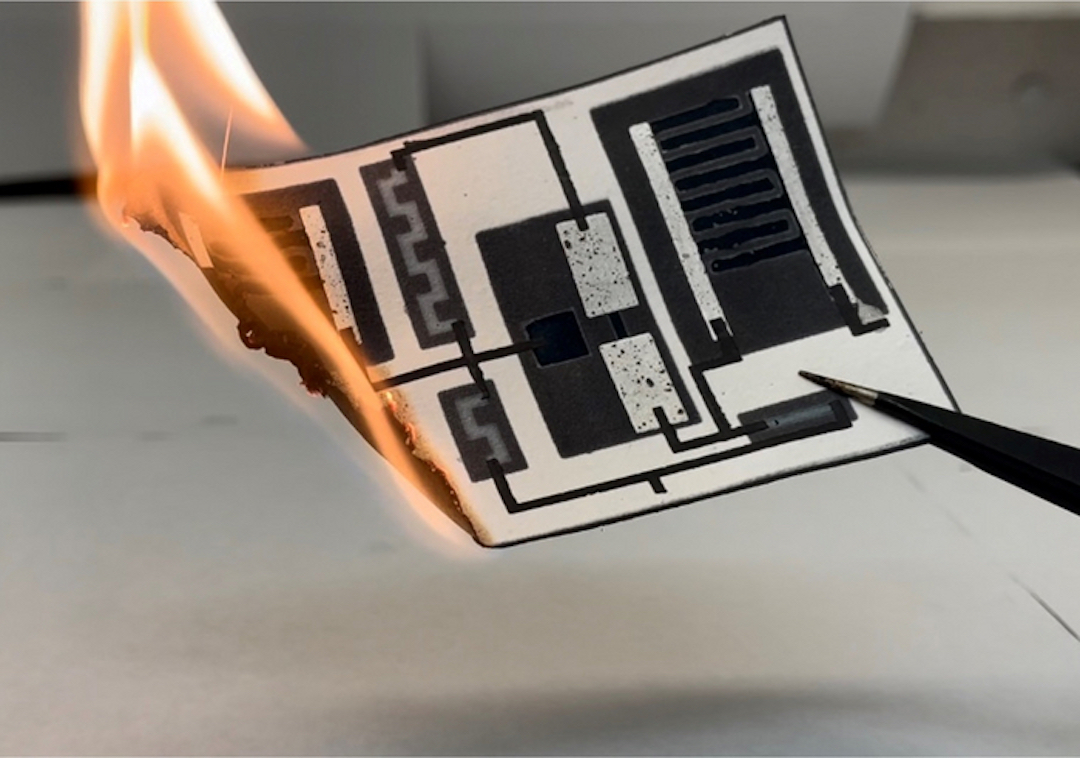
The prototype, made from a single sheet of paper, not only works with fully-integrated electrical components, but can also simply be burnt or left to degrade once the user is done with it.
To develop this new version of the paper circuit board, the scientists used wax to print channels onto a sheet of paper, then melted the wax so that it soaked into the material.
After which, they printed semi-conductive and conductive inks onto the areas not covered by wax, and added screen-printed conductive metal components and a gel-based electrolyte onto the sheet.
Amazingly, the resistor, capacitor, and transistor on the sheet of paper worked. Not to mention, the final result was a thin, flexible piece of paper, which was quickly burnt to ash when it was no longer needed.
Could this be a step towards completely disposable electronic devices? Going forward, the team will look into replacing the non-biodegradable materials in its prototype with those that can be easily broken down.
[via New Atlas and American Chemical Society via EurekAlert, cover image adapted from ACS Applied Materials & Interfaces 2022, DOI: 10.1021/acsami.2c13503]


