
This Mondrian Masterpiece Had Been Hung Upside Down For 75 Years, Museum Posits
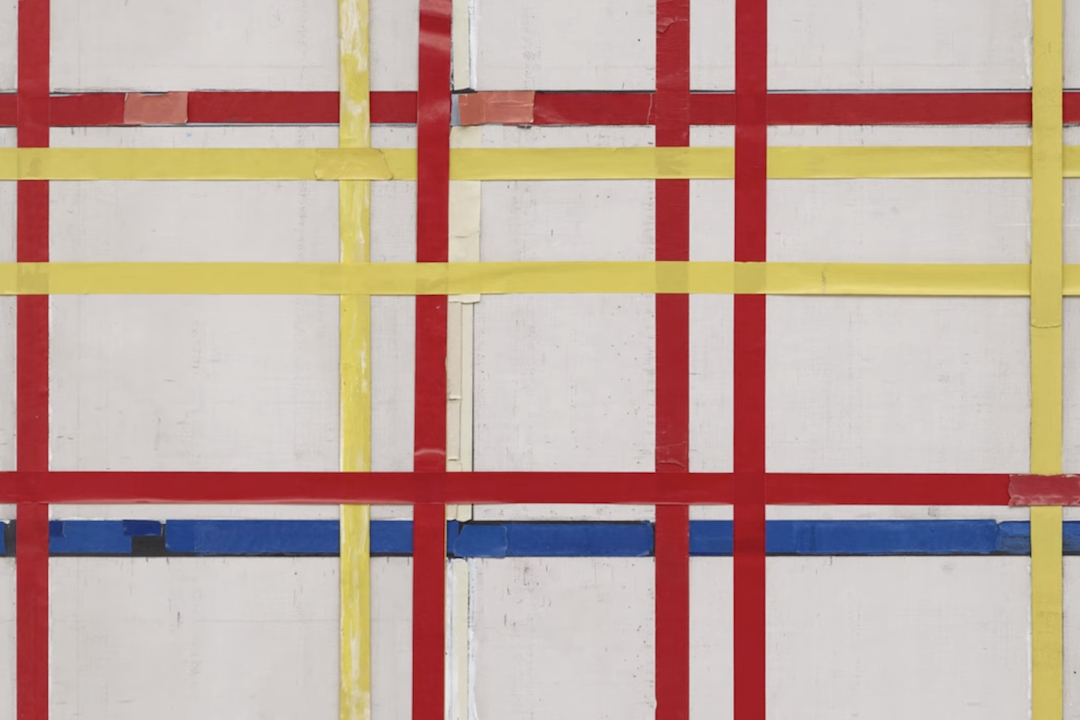
With abstract artworks, it can often be difficult to decipher where a painting begins and ends—could this be the case with one of Piet Mondrian’s famed pieces?
It certainly seems so, with curator Susanne Meyer-Büser announcing at the opening of the artist’s exhibition at Germany’s Kunstsammlung Nordrhein-Westfalen K20 Museum that one of the displays, New York City 1 (1941), may have been hung upside down since it was first seen in public 75 years ago.
According to Monopol, the expert’s suspicions were aroused when she saw a photograph of the artist’s studio dating back to 1944, in which the adhesive-tape work can be seen placed on an easel with the yellow, blue, and black stripes clustered together at the top.
However, when it first appeared at New York’s Museum of Modern Art a year later, the thick grouping of colored stripes was seen towards the bottom of the piece instead of the orientation in the image.
Could an unwitting curator have flipped it upside-down years ago, and we’re just finding out it was displayed wrongly the whole time?
ARTnews noted that Meyer-Büser’s evidence goes beyond just the single picture, explaining that the process of weaving the colors together would’ve been much harder if the artist had worked from the bottom up.
In addition, the typical iteration of the work shows harshly-torn tape left at the top, not reaching the edge of the canvas, which could point to that being the bottom or end of what Mondrian was working on.
Interestingly, despite the claims, the art piece will still be displayed in the same way it’s always been for the exhibition, as there’s the risk of destroying the work should it be flipped.
Perhaps, it’s possible there was never meant to be a “correct” orientation of the abstract work in the first place.
Here's a heads-up: New York City 1 will go on display from October 29, 2022.
[via ARTnews and Kunstsammlung Nordrhein-Westfalen K20 Museum, cover image via Kunstsammlung Nordrhein-Westfalen K20 Museum]


