
Hair Follicles Grow In Lab For First Time, The Root Of Future Treatments
Photo 219371130 © Felipe Caparros Cruz | Dreamstime.com
Japanese researchers have, for the first time, grown mature hair follicles in a laboratory. This breakthrough is only the beginning, but if all goes well, it could help experts discover a cure for hair loss.
Outlining the study in the Science Advances journal, the team at Yokohama National University says it first observed mini versions of an organ, called hair follicle organoids, to study things like growth factors, activators, and inhibitors.
The team, led by Junji Fukuda, applied a special gel onto the organoids—made from baby mice skin cells—which allowed it to reprogram the hair follicles cells to encourage sprouting. The researchers believe they’ve developed the beginnings of in vitro hair follicle growth.
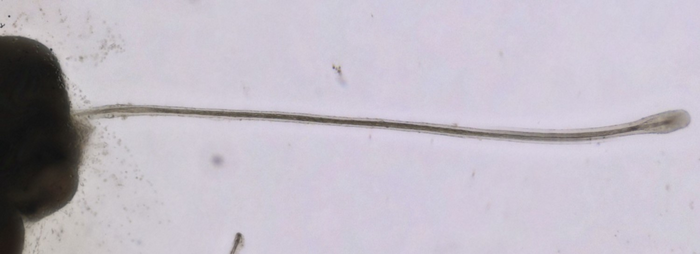
“A representative long sprouting hair follicle generated from hair follicloids after an extended period of culture.” Image via Yokohama National University / EurekAlert
In nature, hair follicles are formed in embryos in response to interactions between skin cells and connective tissue. The gel stimulated these actions by enabling hair’s surrounding cells—such as the epithelial cells—to crawl above and wrap around each other, similar to the way hair follicles perform in the body.
The follicles continued growing for up to a month before reaching three millimeters in length. Fukuda deduces that the rate correlates with the hair cycle of mice.
Moving forward, the scientists are looking to replicate the test with human cells.
Kairbaan Hodivala-Dilke, a cell biologist at Queen Mary University of London who wasn’t involved in the program, tells New Scientist that although the results are preliminary and won’t immediately treat baldness, they might spur new advancements for a cure within the field.
In time, scientists could collect hair from a person with a head full of luscious locks and grow it in a lab for a transplant, says Hodivala-Dilke.
[via New Scientist and Futurism, images via various sources]


