
Disabled Victorian Artist Sarah Biffin Has Her First Exhibition In A Century
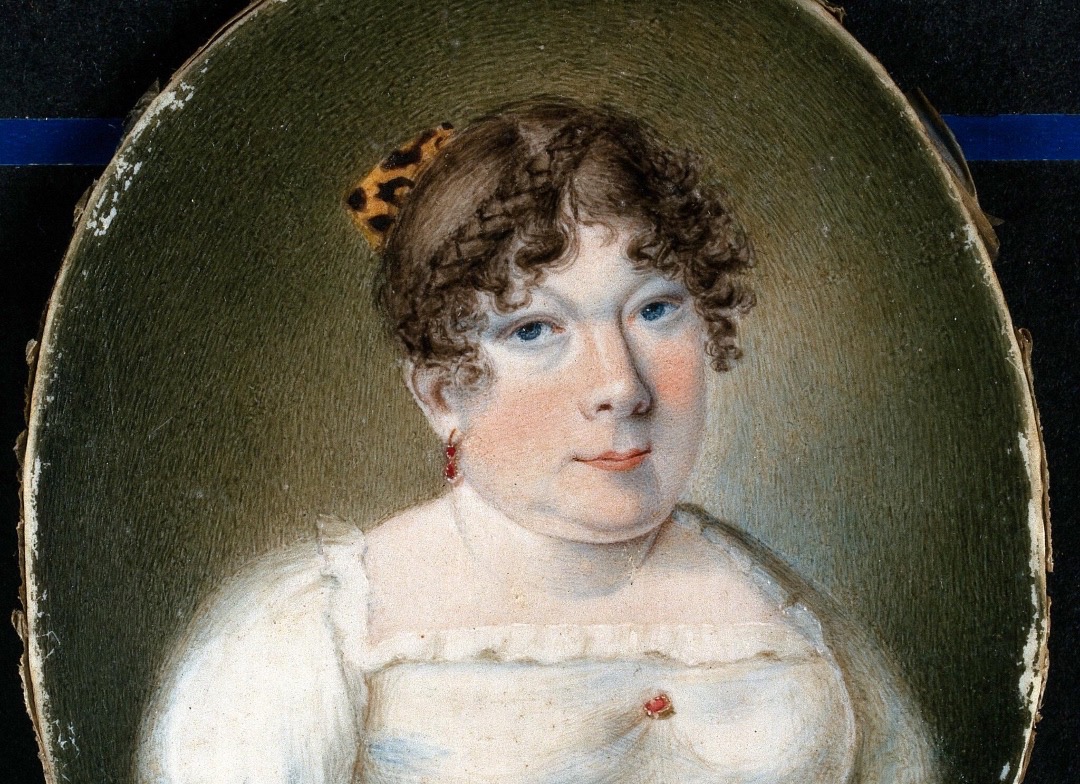
Sarah Biffin. Watercolor by Sarah Biffin, 1812. Image via Wellcome Collection (public domain)
Born without arms and legs, Sarah Biffin stood out in buttoned-up 19th century. She was, in fact, recruited as an attraction at a traveling show, touring England as a “limbless wonder” and the “Greatest Wonder of the World.”
Biffin was born in 1784 as a child of poor farmers in East Quantoxhead in Somerset. She had phocomelia, a rare birth defect resulting in undeveloped limbs. Still, she was confident she’d develop dexterity on par with the other children. At the age of eight, against her parents’ instruction—they felt her conviction was “impractical,” she’d recount later—she taught herself to thread a needle with her mouth and shoulder.
The girl learned to sew her own dresses, tie knots, and taught herself to write.
And, in spite of all odds, she grew up to become a miniaturist.
Biffin’s works are now on show at the Philip Mould Gallery in London, where they’ll stay up until December 21. Without Hands: The Art of Sarah Biffin, the first exhibition showcasing her art in 100 years, honors her determination to lead a regular life as a disabled woman in 1800s England.
View this post on Instagram
Alison Lapper, a contemporary artist who also has phocomelia, was an advisor to the show. She worked with the exhibition’s curator Emma Rutherford to ensure Biffin’s disability was represented respectfully.
View this post on Instagram
Biffin got her breakthrough in art at the age of 24, when she met George Douglas, the Earl of Morton, who introduced her to renowned portrait painter William Marshall Craig. The artist taught her to paint—some 40 years before most women were allowed to attend Royal Academy Schools, according to the Telegraph.
View this post on Instagram
Telling the Guardian, Rutherford notes that, despite Biffin’s condition limiting her in so many ways, it was interesting how it also opened other doors for her that abled women couldn’t get to.
Biffin’s delicate art and story fascinated the elite, drawing the awe of anyone from Charles Dickens—who wrote about her in novels—to Queen Victoria. In 1821, the 37-year-old painter was presented with the prestigious Silver Medal by the Society of Art.
View this post on Instagram
Two centuries later, her self-portraits are now on show next to her letters at a London exhibition.
Biffin married a man named William Wright when she was 40. He wasn’t the best of husbands, supposedly whittling away her life savings and then leaving her. It was one thing to use up her money, but he also erased some of her good name—albeit inadvertently. For many years, a number of Biffin’s works were lost to time as she had signed them with “Mrs Wright” instead of Sarah Biffin.
In her later years, Biffin moved to Liverpool so she could soon move to America to further her art career. However, she died from health complications before she could travel across the pond.
Without Hands: The Art of Sarah Biffin came about after a surprising conclusion at an auction in 2019, when a self-portrait of hers went under the hammer for £137,000 (US$157,000), far surpassing its estimated value of up to £1,800 (up to US$2,065).
View this post on Instagram
[via The Guardian and The Telegraph, images via various sources]


