
First-Ever Written Sentence Is Discovered, And It Tells Of Our History With Lice
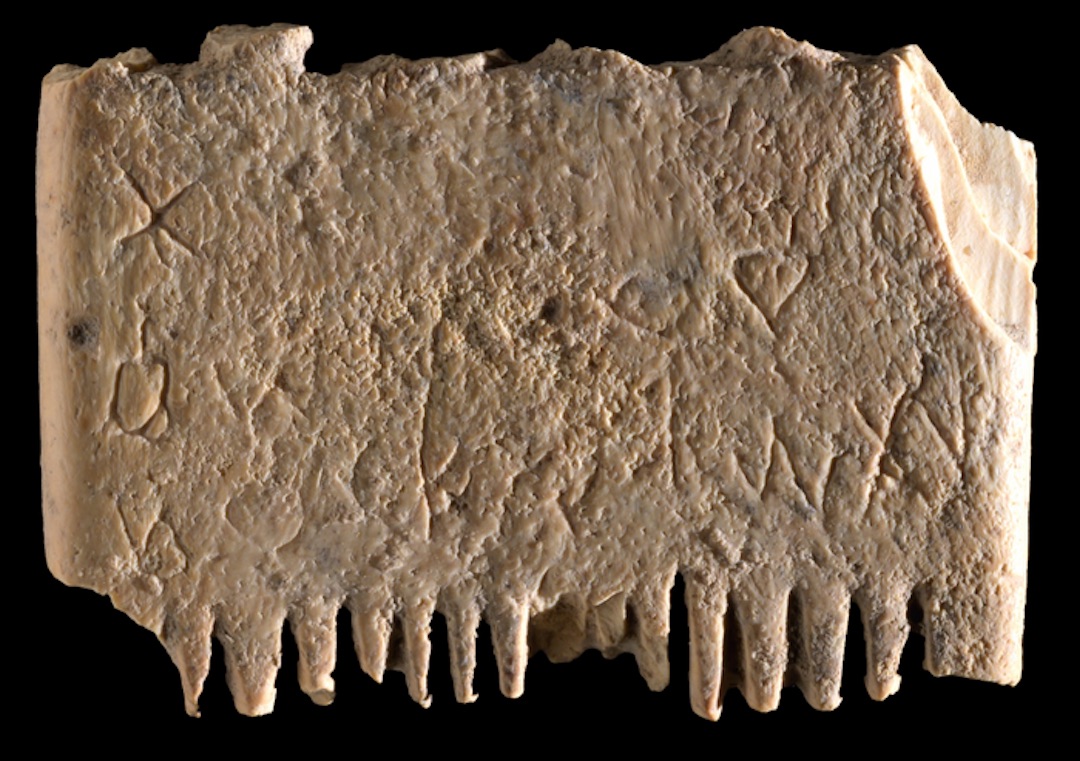
In the ancient city of Tel Lachish in Israel, scientists have discovered what may be the earliest-ever written sentence. Funnily enough, it depicts a lifelong battle we humans have faced against… lice.
The sentence was found on a lice comb, an accessory that was apparently used in getting rid of the parasite for many millennia. On this ivory antique are the words, “May this tusk root out the lice of the hair and the beard,” in the Canaanite language.
The discovery was made by Professors Yosef Garfinkel, Michael Hasel, and Martin Klingbeil from the Hebrew University of Jerusalem and Southern Adventist University in the US.
As per the study published in the Jerusalem Journal of Archaeology, the team believes the phrase is a spell written on the grooming apparatus to help ward off the insect and help with clean and swift removal from the body.
As it turns out, lice were one of the 10 plagues of Egypt and would have also affected the Canaanites.
The comb is a small artifact measuring 1.4 by one inch. It has six thick teeth and 14 smaller ones to help it get rid of head louse eggs. On it are 17 pictographic Canaanite characters in an archaic form, which the researchers predicted was one of the earliest stages of this alphabet’s development.
Below is an image of the place where it was found.

According to Professor Yusef Garfinkel, the line is “the first sentence ever found in the Canaanite language in Israel.”
“There are Canaanites in Ugarit in Syria, but they write in a different script, not the alphabet that is used today. The Canaanite cities are mentioned in Egyptian documents, the Amarna letters that were written in Akkadian, and in the Hebrew Bible,” adds Garfinkel.
This also suffices as evidence that the alphabet was used in daily life over 3,700 years ago, which wasn’t to dictate the ownership of an object. Furthermore, the person who carved the characters did so with such skill that each letter is only one to three millimeters wide.
The Canaanites, as it turns out, were the first to utilize the alphabet before they spread to other communities around the globe in 1800 BCE. This breakthrough would help scientists better understand the literacy state in Canaan during the Bronze Age.
[via Interesting Engineering and The Hebrew University of Jerusalem, images via EurekAlert]


