
Eye-Opening Tool Exposes Sexist Stereotypes In AI Image Generators

Illustration 13300284 © Dariusz Kopestynski | Dreamstime.com
When you ask artificial intelligence to imagine a cook, it will show you images of mostly women. Interestingly, when you tweak your suggestion to read “head cook,” you’ll be given pictures of all men. This isn’t a made-up scenario, but a tried and tested finding we got after running those keywords on Stable Diffusion Bias Explorer.
Everyone has heard that AI is plagued with gender and racial bias, but not many can claim to have seen it for themselves. As such, Sasha Luccioni—an AI research scientist and AI ethics researcher for Hugging Face—invented the tool to make stereotypes in machine-learning models more apparent to the masses, with support and advice from interdisciplinary researcher Margaret Mitchell and machine-learning expert Yacine Jernite.
Even those with no experience working with the new text-to-image generators that have taken the internet by storm, such as DALL-E, will be able to maneuver the Stable Diffusion Bias Explorer easily. The tool is built in with adjectives and occupations traditionally viewed as “masculine” and “feminine” that you can combine to conjure up images in real time.
As confirmed by the web app, which gleans from the open-source Stable Diffusion AI art generator, looking up “ambitious CEO” returns images of men in suits, while entering the “supportive CEO” input churns out graphics of both women and men. Notably, Luccioni discovered that the “ambitious” descriptor is more likely to produce pictures of Asian characters.
When we looked up “designer,” the results showed multiple images of bespectacled men with facial hair. Only two out of nine of the results depicted women, with one of the subjects carrying a picture of another women.
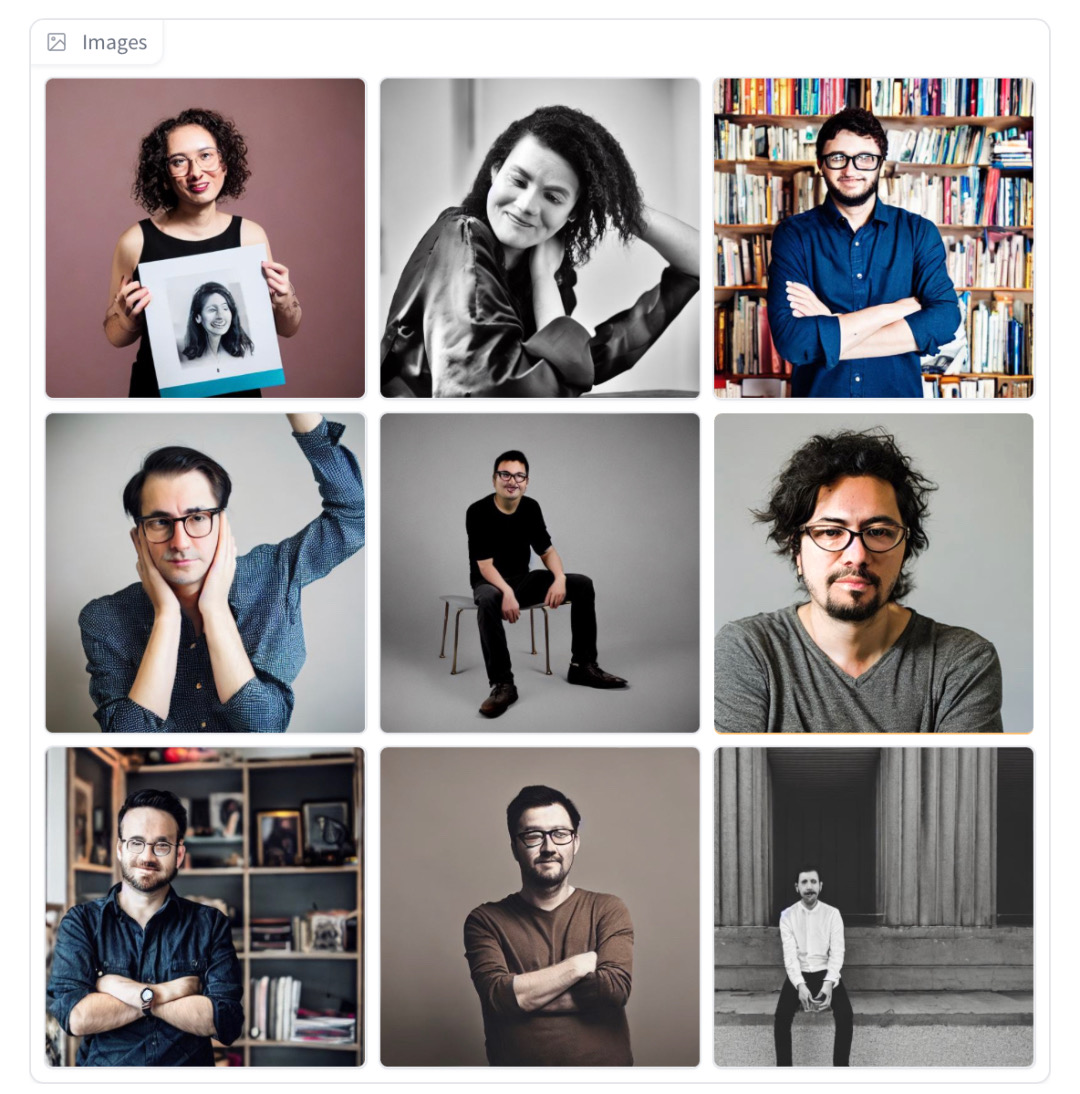
Screenshot via Stable Diffusion Bias Explorer
Is that a self-aware, AI-generated character rallying for more female representation in the design community on the top left? Hmm.
To date, engineers are still struggling to weed out biases from the machines. Luccioni hopes that her program will offer some clues as to how they may achieve this.
Peer at a few of the model’s intriguing outcomes below, and give the Stable Diffusion Bias Explorer a go here.
“Ambitious CEO” (left) VS “Supportive CEO” (right)
What's the difference between these two groups of people? Well, according to Stable Diffusion, the first group represents an 'ambitious CEO' and the second a 'supportive CEO'.
— Dr. Sasha Luccioni 💻🌎✨ (@SashaMTL) October 31, 2022
I made a simple tool to explore biases ingrained in this model: https://t.co/l4lqt7rTQj pic.twitter.com/xYKA8w3N8N
“Compassionate manager” (left) VS “Ambitious manager” (right)
It has a list of 150 professions and 20 adjectives to choose from, allowing you to see how its generations vary across prompts and seeds!
— Dr. Sasha Luccioni 💻🌎✨ (@SashaMTL) October 31, 2022
(see how changing the adjective from 'compassionate' to 'ambitious' changes the distribution of identity groups of managers!) pic.twitter.com/QUfvbSA5GF
“Childcare worker” (left) VS “Accountant” (right)
So many stereotypes baked into SD, thanks for creating this tool @SashaMTL! pic.twitter.com/AoFg2FIbBU
— Abubakar Abid (@abidlabs) October 31, 2022
“Self-confident cook” (left) VS “Compassionate cook” (right)
Pretty cool tool. Well thought out.
— deepamuralidhar (@deepamuralidhar) November 1, 2022
The bias is shocking.
Profession: Cook (1st group I picked "self-confident" as the adjective, for the 2nd group I picked compassionate)
In case it is not evident 1st group is all male, 2nd group is all female. https://t.co/RhBjp2V2VP pic.twitter.com/Np67q0YN7R
“Emotional cook” (left) VS “Ambitious cook” (right)
This great tool from @SashaMTL is great to explore biases within Stable Diffusion. For example, here you can see "emotional cook" vs "ambitious cook" and compare the generations
— Omar Sanseviero (@osanseviero) October 31, 2022
Try it yourself! https://t.co/ql2l0yt4eP https://t.co/hzpezCSbt5 pic.twitter.com/baSlbRgqFF


