
NASA Finally Launches Its Most Powerful Rocket 50 Years After Its Last
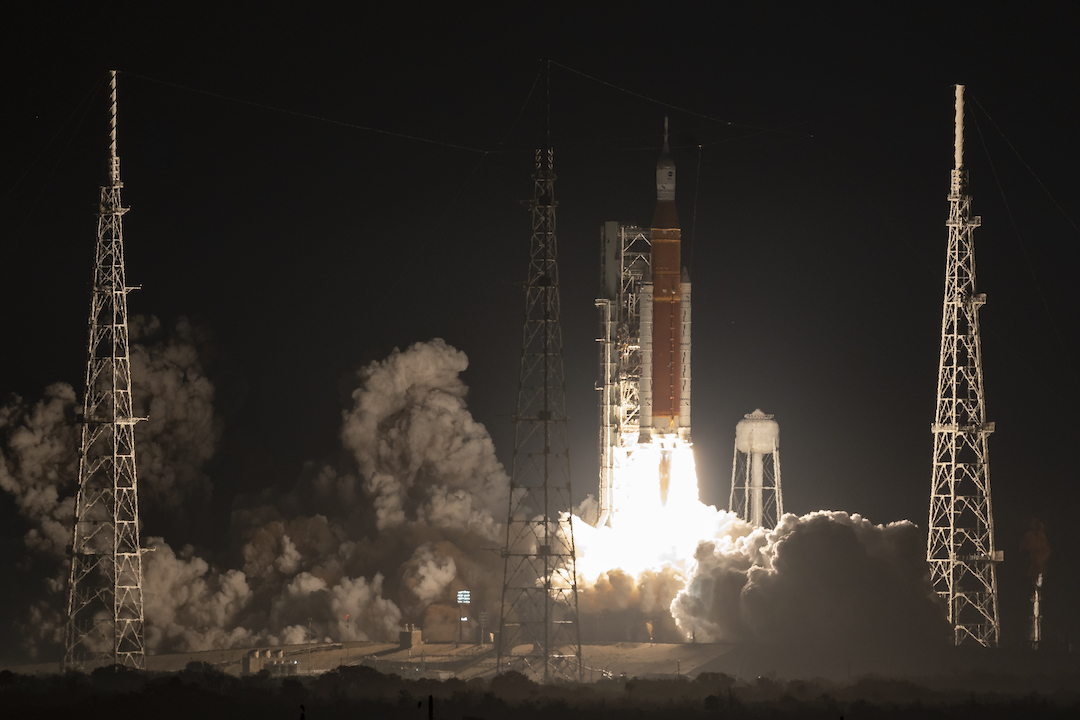
For the first time in five decades, NASA has launched the most powerful rocket in the world toward the moon from its Kennedy Space Center in Florida.
The flight test, which is part of preparations for its upcoming Artemis II human mission, will be a key measure of the Orion spacecraft, Space Launch System (SLS) rocket, and ground systems.
According to the agency, the launch marks the first leg of Orion’s mission—known as Artemis I—in which the space capsule is planned to travel 40,000 miles beyond the Moon and return to Earth, all in 25.5 days.
Orion correctly deployed its solar arrays once reaching initial orbit, and one and a half hours into the flight, the rocket successfully fired from its upper stage engine to give the spacecraft the lift it needed to rise out of Earth’s orbit and begin its journey toward the Moon.
We are going.
— NASA (@NASA) November 16, 2022
For the first time, the @NASA_SLS rocket and @NASA_Orion fly together. #Artemis I begins a new chapter in human lunar exploration. pic.twitter.com/vmC64Qgft9
At the moment, the capsule has separated from its upper stage, and is on its flight plan to the Moon while being powered by its service module, a propulsive powerhouse created in collaboration with the European Space Agency.
Throughout the trip, a series of 10 science and technology demonstrations will be taking place. Dubbed CubeSats, each one has its own mission to fulfill, hoping to give scientists additional insights into our solar system, or test our technologies that could benefit future missions.
NASA engineers will be waiting with bated breath till November 21, when Orion is scheduled to fly past the Moon, closely approaching the lunar surface as it speeds to a distant retrograde orbit beyond La Luna before turning back.
“The Space Launch System rocket delivered the power and performance to send Orion on its way to the Moon. With the accomplishment of the first major milestone of the mission, Orion will now embark on the next phase to test its systems and prepare for future missions with astronauts,” said Mike Sarafin, Mission Manager of Artemis I.
Missed last night's #Artemis I launch?
— NASA (@NASA) November 16, 2022
Catch the highlights from our next big step in returning humanity to the Moon. https://t.co/T2VEPMVLjP pic.twitter.com/j3GChmR2Ko
[via AP News and NASA, cover image via NASA / Bill Ingalls]


