
Scientists Recreated A Black Hole In A Lab, And It Began To Glow And Radiate
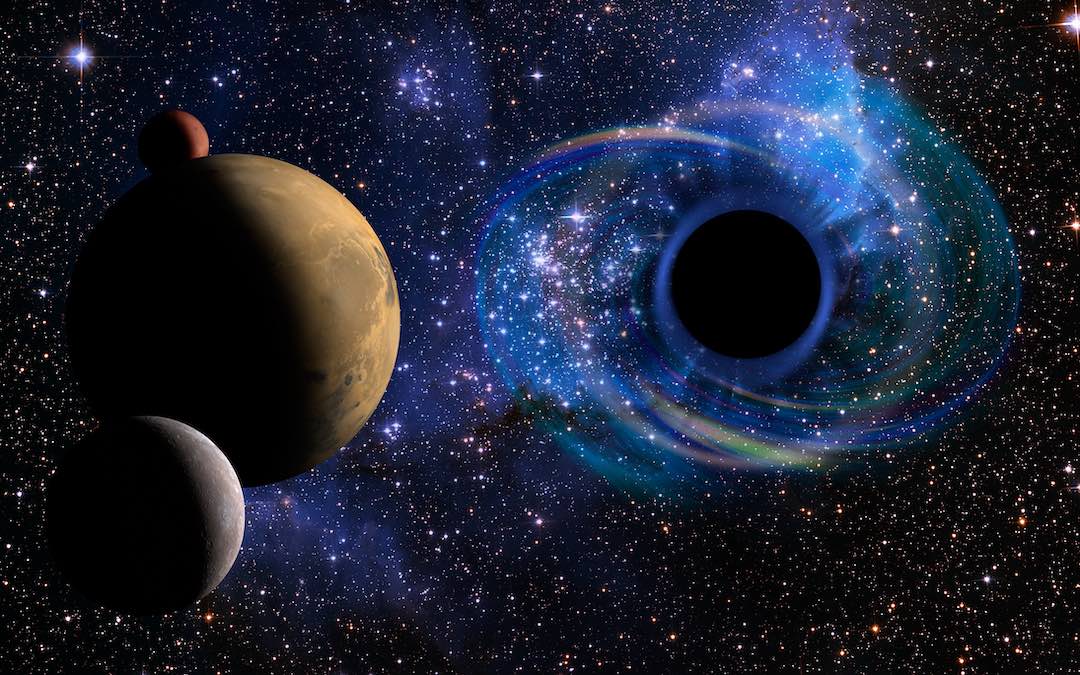
At the University of Amsterdam in the Netherlands, scientists successfully recreated a black hole in a lab that brought the team closer to proving Stephen Hawking’s theory of radiation emitting from a black hole.
Hawking’s theory, known as Hawking radiation, is a glow created by disturbances in particles in quantum fluctuations as a black hole tears through spacetime. He proposed that these quantum fluctuations released a type similar to thermal radiation. However, this has always been too far from Earth to test.
To prove his theory, the team created an event horizon analog that could exist within the confines of a lab.
The event horizon of a black hole is the area in which no light or matter can pass through. And as no one knows what happens within this portion, there are many theories, some of which include that it could be a portal into distant regions of the universe.
To recreate this, the scientists used a single-file chain of atoms to simulate the event horizon, and as they did so, they watched on as it began to glow, just as Hawking theorized.
Their one-dimensional chain of atoms formed an environment that allowed electrons to “hop” between different positions. This motion made a type of event horizon that disrupted the wave-like nature of the electrons and produced Hawking radiation.
The scientists explained that this produced a rise in temperature that matched what was hypothesized in theory. However, this only took place when the chain of atoms extended beyond the event horizon. As a result, this would mean that this mashup of particles caused the black hole to glow.
Ultimately, this breakthrough brings researchers closer to consolidating Hawking’s general theory of relativity with quantum mechanics.
[via ScienceAlert and Interesting Engineering, Photo 89299175 © Karayuschij | Dreamstime.com]


