
NASA’s Orion Spaceship Shares Compelling Images Of Its Trip To The Moon
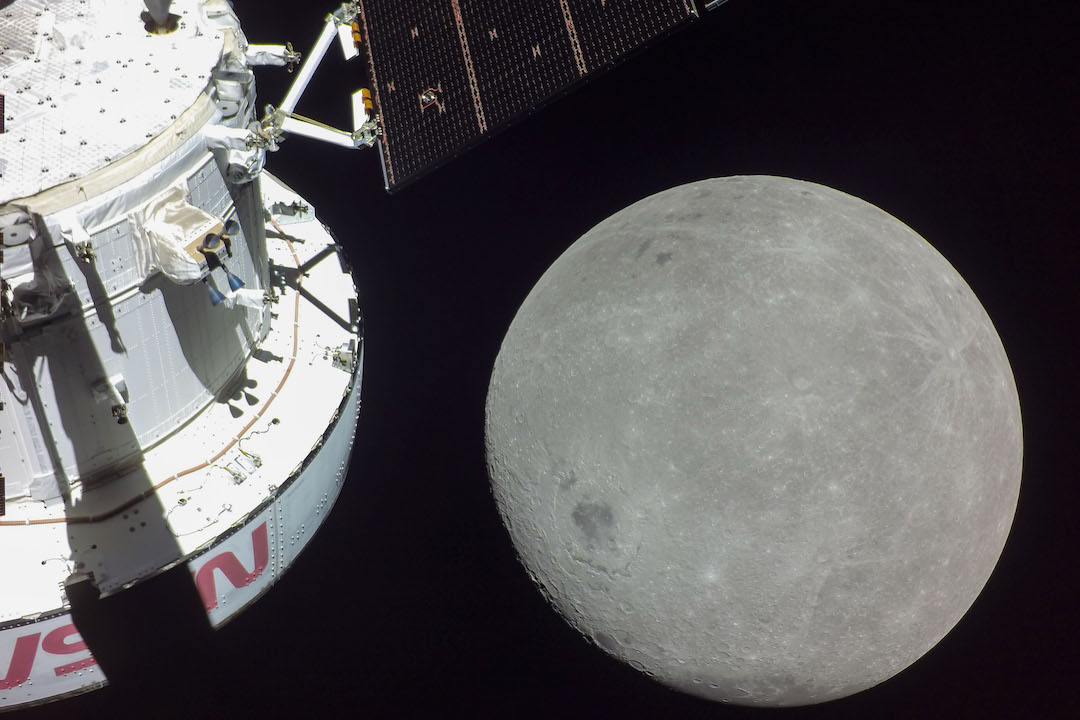
Last week, NASA launched its most powerful rocket to date, hurtling towards the Moon as part of the Artemis I mission, which will test the true capabilities of the Orion spacecraft, Space Launch System (SLS) rocket, and ground systems.
Now, the agency has unveiled images from one of the most critical points of its journey—the lunar fly-by—as the space capsule hovered just over 80 miles above the surface of La Luna. In the coming week, Orion will travel a further 40,000 miles beyond the Moon.
Posting an incredibly close-up shot of the Moon on Twitter, NASA reported that the spacecraft successfully achieved “the closest approach of the uncrewed mission.” After which, the capsule looked back to capture our small, blue planet in the distance some 230,000 miles away.
Fly-by complete!@NASA_Orion completed its closest fly-by of the Moon this morning, 81 miles above the lunar surface, traveling 5,102 mph. Before the fly-by, we conducted an outbound powered fly-by burn, increasing speed at a rate of more than 580 mph: https://t.co/gqViM3BJLg pic.twitter.com/9IUkQUj4pf
— Jim Free (@JimFree) November 21, 2022
According to Mashable, mission engineers are currently testing out Orion’s capabilities in different lunar orbits, and will eventually settle in a special orbit that will help it go beyond the natural trajectory of the Moon.
All eyes will be on how the spacecraft fares as it completes the second half of its mission, especially if it will survive the red-hot temperatures when it whizzes through the Earth’s atmosphere at 24,500 miles per hour upon re-entry.
[via Mashable and NASA, cover image via NASA Johnson Space Center]


