
Scientists Reconstruct Face Of Accused 19th-Century ‘Vampire’ Using His DNA
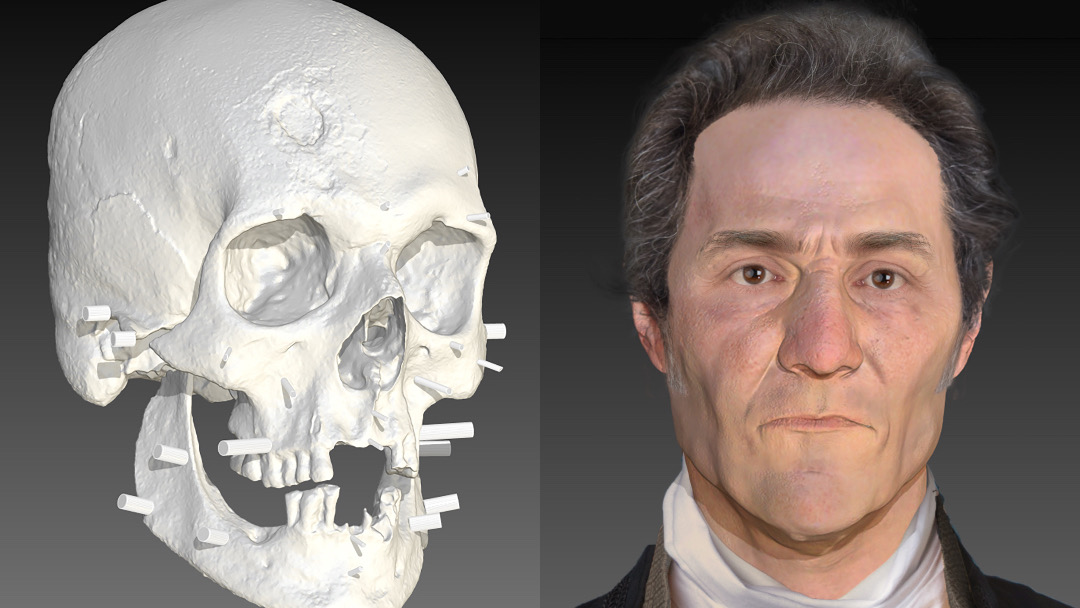
Images via Parabon NanoLabs / EIN Presswire
Before science brought answers, disease and illnesses were blamed on curses, dark magic, and supernatural beings. As for the tuberculosis epidemic in the 1800s, it spawned the New England vampire panic. Instead of getting the medical help they needed, victims were instead condemned as “vampires” after death and had their corpses rearranged to prevent them from jumping up from their graves and infecting loved ones.
Tuberculosis back then was called “consumption,” and it was believed that those who died from the disease could return and “consume” the lives of relatives. To stop the dead from becoming undead, people would exhume their bodies, burn their internal organs, and rearrange their bones so they could not get out of their coffins.
John Barber was one of the unfortunate, misunderstood victims of the time, when people had no concept of germs or how contagion occurs. Like many who died from the disease, the 55-year-old farmer had his femur bones crossed over his chest to block him from escaping his coffin.
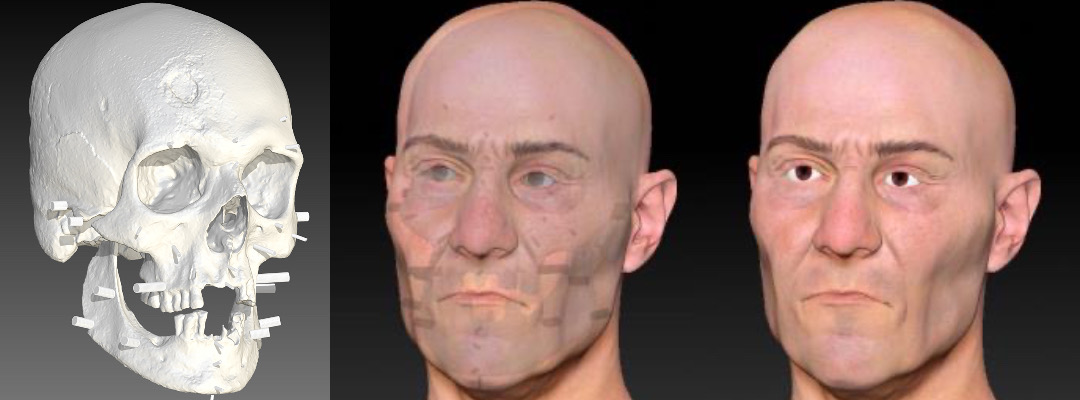
Of course, we now know that Barber wasn’t a vampire but someone who succumbed to his fight with tuberculosis. Forensic scientists at Parabon NanoLabs and the Armed Forces DNA Identification Laboratory have now reconstructed his face after studying his DNA and creating a 3D image of his skull.
The middle-aged farmer was noted to have fair skin, brown or hazel eyes, and dark hair. Experts are also 50% confident he had some freckles, a feature predicted and flagged up by a machine-learning model.
John Barber

The New England man’s facial features are based on scans that show he was toothless, as well as data of “inferred health issues.” His hairstyle is an artist’s interpretation that follows trends popular in the 19th century.
Barber’s remains were uncovered by children who were playing near a gravel pit in Griswold, Connecticut, in 1990, and they have since been studied extensively.
Modern forensics enables scientists to extract DNA from centuries-old bones. Ellen Greytak, director of bioinformatics at Parabon NanoLabs, tells Live Science that this is a difficult undertaking, since historical bones are brittle and capture DNA from surrounding things like bacteria and fungi while fragmenting over time.
Barber was likely the first in his family to be infected with tuberculosis, and it can be assumed that when his other family members contracted the disease, he was blamed as the cause.
The man was buried near his first cousin, Nathan Barber, whose bones were not found in the same placement, suggesting that the relative wasn’t thought to be a vampire.
With fresh memories of a pandemic hanging over our heads, it raises the question of how dangerous it could be if we were still ruled by old wive’s tales, rather than facts, today. Considering COVID-19’s association with bats, we’d have probably believed that people who have contracted it are blood-sucking, shape-shifting bats, too.
[via My Modern Met, Smithsonian Magazine, Live Science, images via Parabon NanoLabs / EIN Presswire]


