
Norwegian Woman From 800 Years Ago Is Reconstructed To Meet Future Generations
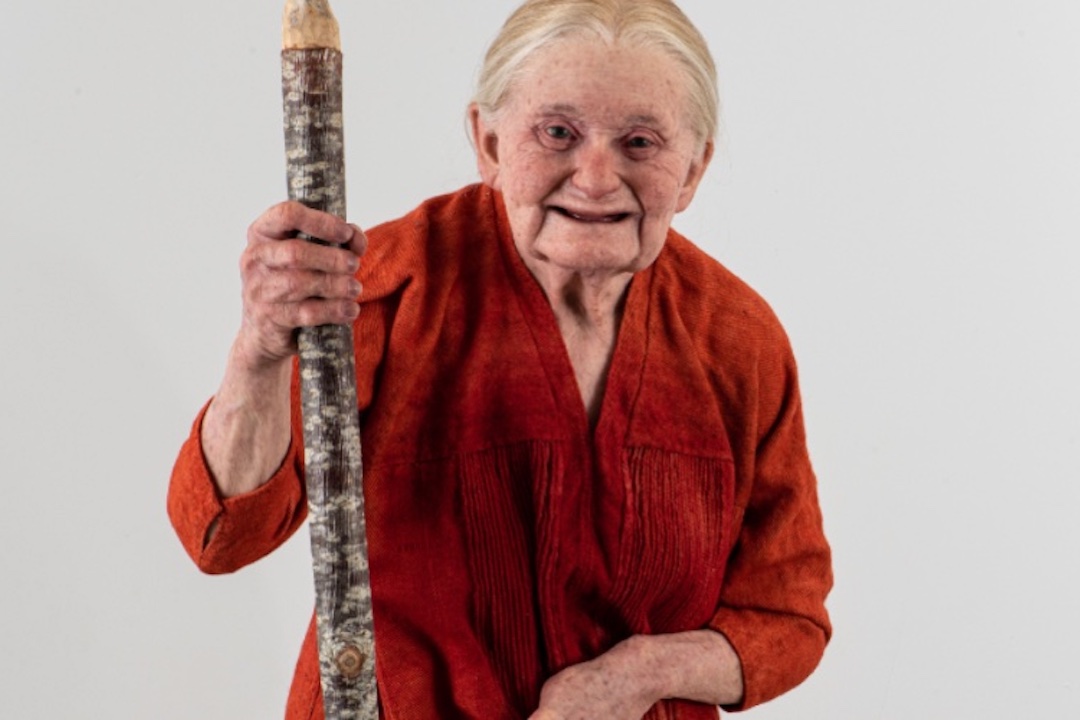
Ever wondered what a Norwegian grandmother who lived almost a millennium ago looked like?
Now you don’t have to imagine, as the Norwegian University of Science and Technology (NTNU) has unveiled a life-sized model of Tora, a 3D reconstruction based on actual human remains excavated in the 70s.
According to Interesting Engineering, the name ‘Tora’ was given through a public poll conducted by Norwegian broadcasting company NRK, and now belongs to the lifelike sculpture that sits as part of an exhibition at the university’s museum.
Tora’s birthplace—or rather, the remains of the ancient woman—was traced back to the city of Trondheim, located in the middle of Norway. It’s believed she lived there in the 1200s, when the city was considered to be at its peak.
During that time, the locale had an estimated population of 4,000 residents, many of whom were merchants and craftsmen. The woman’s bones were found at a cemetery on the main street, known as Kaupmannastretet.
Archaeologist Ellen Grav revealed that it was likely Tora hailed from a merchant family, making her slightly more well-off than others in the city then.
However, as there is no written evidence about her, the team weaved a story of her life purely by looking at her skeletal remains and where her body had been located.
Speaking to Live Science, Grav said that a spinal deformity in Tora’s back led them to believe she could’ve had a hunched back, which, with missing teeth, pointed to “signs of hard work.”
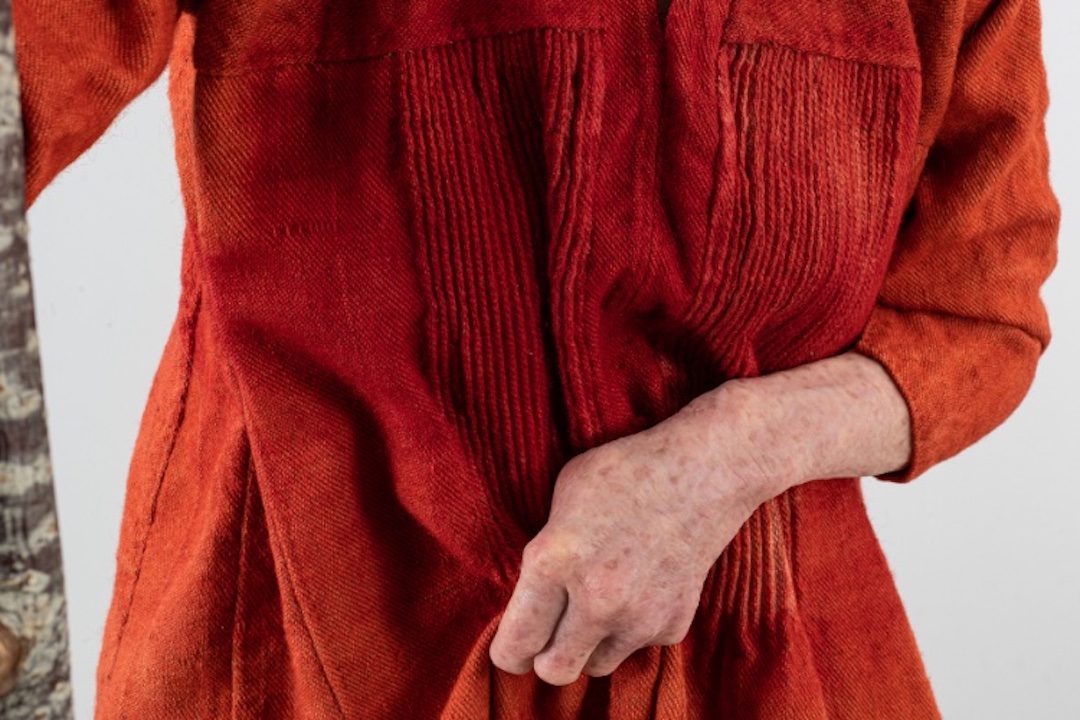
To dress the sculpture, the team was inspired by a real dress found in Uvdal State Church, which dated back to the same period. It was paired with a pair of handmade leather shoes for a “slightly summery feel.”
Impressively, Tora’s dress was hand-sewn by dressmaker Nille Glaesel using “medieval techniques,” following a reconstruction by textile Professor Marianne Vedeler from the University of Oslo.

The model’s lifelike features were all down to one man, Thomas Foldberg, a film makeup artist. He solely relied on the woman’s skeleton—without any X-rays or scans—to create the model, even hand-painting liver stains and other spots.
It was purposeful that the sculpture was created with a kind, welcoming expression, as researchers felt it would allow the audience to “better connect” with the medieval human.
Tora is still on show at the Norwegian University of Science and Technology (NTNU) University Museum. Head here for more details.
[via Interesting Engineering and Live Science, images via Norwegian University of Science and Technology]


