
Meta Shares Open-Source Tool For Spotting Terrorist Content Online

Meta has opened the doors to an open-source tool that other social media platforms can tap on to spot and track problematic images and videos, including terrorist threats or child sexual abuse content.
This move comes as the company assumes the chair of the Global Internet forum to Counter Terrorism (GIFCT)’s Operating Board next month, in a bid to tackle terrorist content spreading online through research, collaboration, and knowledge sharing.
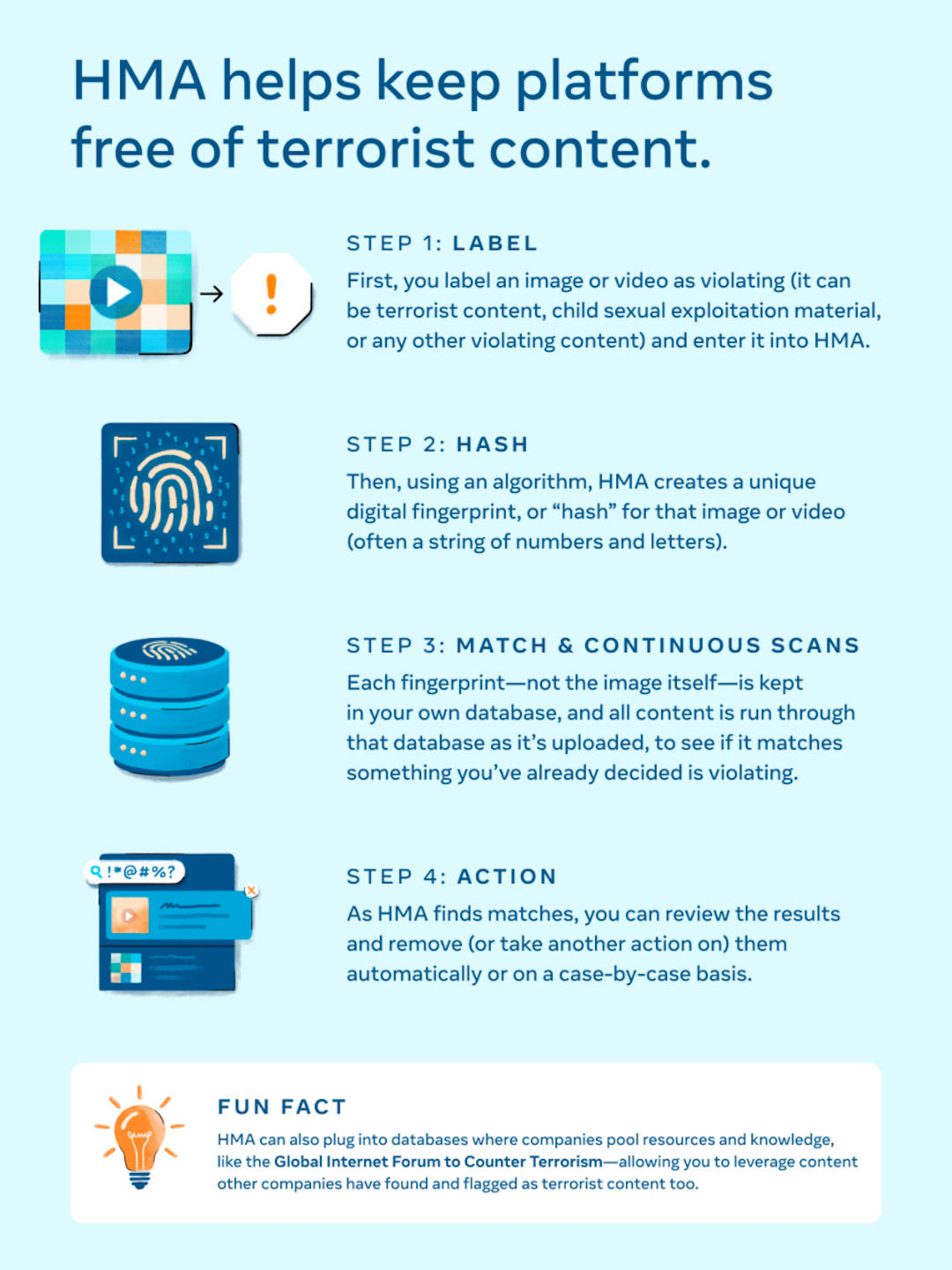
The new tool, dubbed the Hasher-Matcher-Actioner (HMA), will allow social networks to identify suspicious images or videos and take action against them in one go. It was built on the firm’s previous matching software, and can be used to identify any type of violating content.
Once an image or video has been labeled as violating content policies, it will be entered into HMA, after which the software uses an algorithm to generate a unique “hash” for the item. From then on, all content will be run through the database of hashes to spot anything already flagged.
If violating material is spotted by HMA, administrators will be able to view the results of the search and remove or ban such posts automatically or on a case-by-case basis, depending on their needs.
Meta points out that the more companies take part in using the hash database, the better and more comprehensive it will become. And since many companies don’t have the in-house technology to create their own software, it wants to share HMA as a valuable tool in the space.
The firm, which labels itself as “a pioneer in developing AI technology to remove hateful content at scale,” reveals that with its moderation systems, hate speech is now only viewed twice for every 10,000 views of content on Facebook, a decrease of 10 to 11 times from three years ago.
Millions of fake accounts are blocked on a daily basis to prevent the spread of misinformation, and over 150 networks of malicious accounts have been banished from the company’s networks since 2017.
As Dina Hussein, Head of Counterterrorism Policy at Meta, tells Axios, keeping the online space safe isn’t an endeavor for a single entity to accomplish—it is an effort that involves several.


