
Watch As Inflatable ‘Orbital Reef’ Space Station Prototype Blows Up In Test
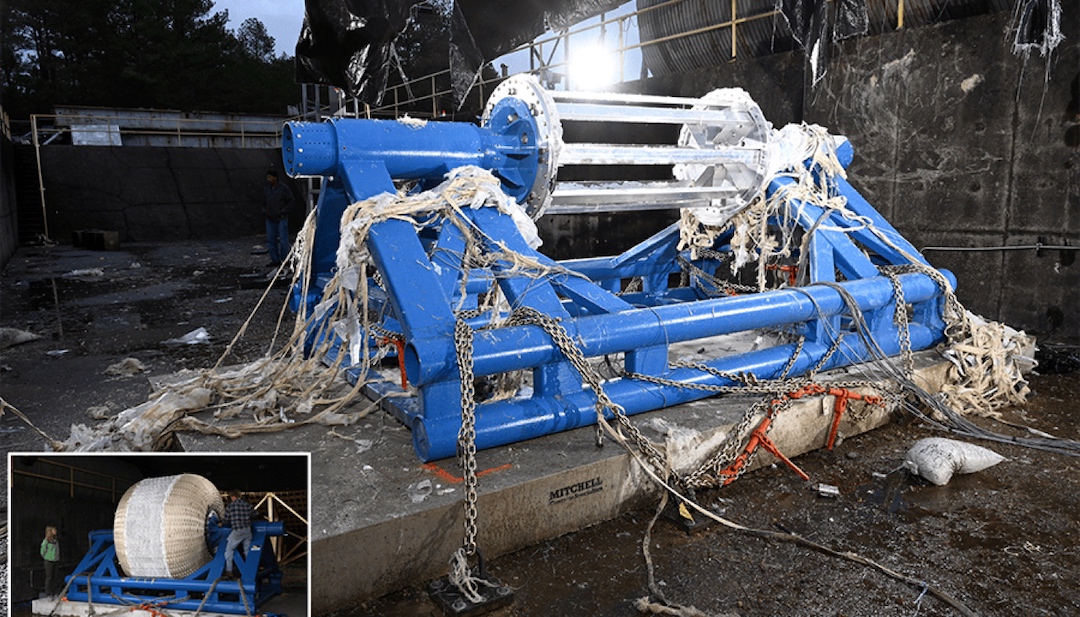
Sierra Space, one of the companies in the race to build a commercial space station, recently announced that it completed a major milestone in its development by successfully blowing up a mini prototype.
The company, which is working alongside Jeff Bezos’ Blue Origin on the project, dubbed Orbital Reef, had scheduled the intentional explosion as part of an “ultimate burst pressure test” (UBP) to ensure the innovation was as safe as possible.
According to the firm, the LIFE (Large Integrated Flexible Environment) habitat successfully achieved its second sub-scale UBP test, following the achievement of its first such experiment earlier in July.
Within the inflatable module is a three-story commercial habitat, complete with its own science platform, that is designed to remain in low-Earth orbit for long periods of time where humans can live and work comfortably in space.
Remarkably, this feat makes Sierra Space the only active commercial space company to have met successful UBP trials, putting it ahead in the race to be the successor to NASA’s International Space Station (ISS).
Organized with the help of NASA experts and ILC Dover, the explosion was carried out in the flame trench of the Saturn 1/1B test stand, where the agency had previously tested rockets for the Apollo program.
The two tests reached maximum burst pressure rates of 192 and 204 psi, respectively, exceeding the safety requirement of 182.4 psi. These early trials will provide data to help improve the reliability of the system going forward.
Full-scale UBP tests are set to begin in 2023, as the firm moves to complete NASA’s certification of the habitat’s primary structure for humans in space; with the possibility of expanding its capabilities further to reach the Moon or Mars.
“This project will service many different opportunities for the new space economy, and the results of this most recent test and milestone are testament to the progress our team is making to enable the next chapter in space commercialization,” said Sierra Space CEO, Tom Vice.
[via Interesting Engineering and Sierra Space, cover image via Sierra Space]


