
First ‘Vagina On A Chip’ Has Been Developed To Boost Discovery Of Drugs

Photo 187385541 © Luchschen | Dreamstime.com
For one of the most essential catalysts for life, it’s strange how little is known about women’s sexual health. One of the main reasons is that vaginal function can’t be mimicked easily in a lab—animal microbiomes are vastly different from those of a human’s. Plus, every vagina has a different cocktail of bacteria.
Scientists at Harvard University’s Wyss Institute for Biologically Inspired Engineering have popped a medical V-card: They’ve invented the world’s first ‘vagina on a chip’, compounding the microbial environment and activity of a human vagina into a tiny, inch-long silicone rubber chip. By consistently simulating the behavior of the female organ, the hope is that the development and testing of treatments for bacterial vaginosis (BV) can be accelerated.
BV is a common form of vaginal inflammation caused by microbial imbalance that affects millions, Scientific American reports. People diagnosed with it are more likely to contract sexually-transmitted diseases or give birth prematurely.
A new chip re-creates the human vagina’s unique microbiome https://t.co/E8gz6fOTVV
— Scientific American (@sciam) December 15, 2022
Researchers can now replicate the less-understood condition via this ‘vagina in a chip’ that captures live human vaginal tissue of a donor and estrogen-carry material that recreates vaginal mucus. They’ve detailed their findings in the Microbiome scientific journal.
Not only does the chip perform like a vagina, but it also reacts to changes in estrogen levels and can even grow “good” and “bad” bacteria, serving as a case study for what a healthy or unhealthy vagina is.
After being fed with the Lactobacilli bacteria, which ensures the vagina retains its acidity, the chip produced lactic acid to maintain a low pH. Meanwhile, the introduction of Gardnerella made the chip alkaline, causing it to suffer cell damage and inflammation—which happen to be symptoms of BV.
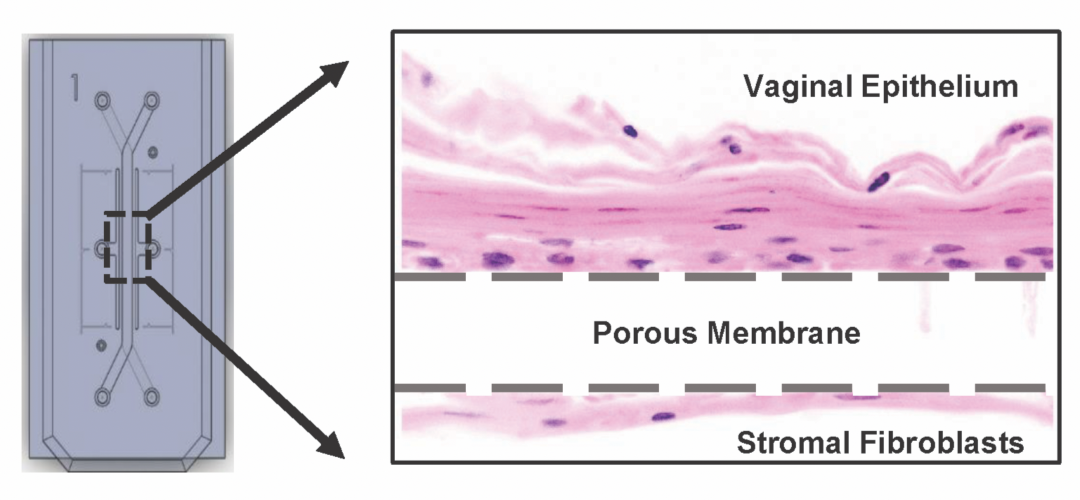
Image via Wyss Institute at Harvard University
Critics have pointed out that such “organs on chips” only simulate the activity of body parts that have been isolated. In this case, the vagina chip might not be able to replicate changes that occur during pregnancy since other associated organs aren’t in the equation. However, Don Ingber, one of the chip’s creators, notes that replicating pregnancy and other complex processes may not require too many bells and whistles as one expects.
Following this breakthrough, the team is looking to create personalized vagina chips incorporating the varied microbiomes of several individuals, whose personal bacterial environments will be sampled through vaginal swabs.
On top of inventing the vagina-on-a-chip, Ingber’s team is now developing a cervix chip to better illustrate reproductive function on a whole.
Such chips will unlock new secrets for women’s reproductive health, whose evidence currently stands as “very, very, poor,” remarks sexual health physician Achyuta Nori of St. George’s at the University of London, who was not involved in the research. At long last, we’ll have some answers that can only be guided by modern technology.
More than that, Ruth Mackay of Brunel University London, who also did not participate in the project, revels that it could help normalize and bust the stigma on studies surrounding the human vagina.
[via Scientific American and The Independent, images via various sources]


