
This ‘Living’ Tamagotchi-Like Smartwatch Literally Dies If You Forget To Feed It
Every year, lines snake outside Apple and Samsung stores when the latest lineup of gadgets launch, with millions all over the world eager to replace their existing devices with the newest the sphere of technology has to offer.
Such consumer behavior no doubt has consequences, one of which is the exponentially growing levels of electronic waste—the fastest-growing category of disposables—in which 40 million tons of e-waste is generated annually.
As such, scientists Jasmine Lu and Pedro Lopes at the University of Chicago have come up with an experiment to test if they could change this fickle relationship we have with our devices, by bringing them to life—quite literally.
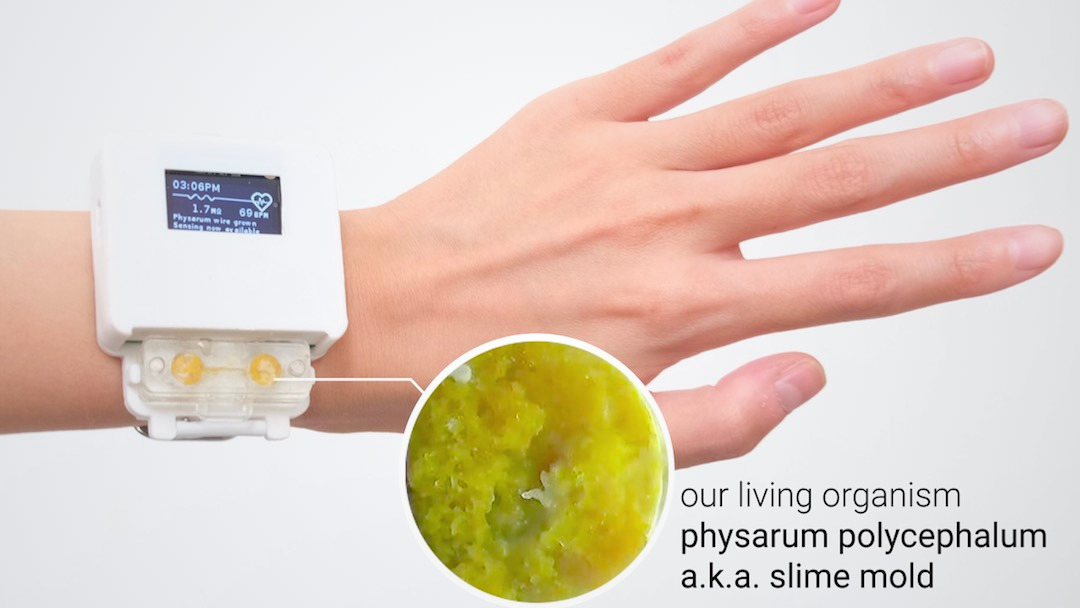
In the same vein as keeping a virtual Tamagotchi pet alive, the researchers created a smartwatch that housed an electrically conductive single-cell organism known as ‘slime mold’, requiring the user to consistently feed the creature in this symbiotic relationship.
“People were forced to think about their relationship to devices in a lot of really interesting ways. And with this device, it felt more like a bi-directional relationship because they had to care for it,” explains Lu, who is a fourth-year graduate student at the Human-Computer Integration Lab.
The wearers of this smartwatch—which could tell the time and measure its owner’s heart rate—developed an attachment to the gadget due to it being “alive,” as they couldn’t just toss it aside or store it in a closet without feeding the organism.
Users needed to regularly feed the “blob” with a mixture of water and oats to help it grow. When the slime mold eventually reaches the other side of its enclosure, an electrical circuit is fully formed, allowing the smartwatch to begin its heart rate monitor function.
Five participants donned the watches for two weeks. The first week involved feeding the slime mold till the heart rate feature was activated, while during the second week, users were told to stop feeding the organism, so it would dry up and disengage the monitor.
Throughout the 14 days, those involved in the study were tasked to journal about their feelings, and answered interview questions about their ongoing relationship with the rather strange device.
Interestingly, most wearers developed a high level of attachment to the watch, likening it to a pet. Some even named it, or asked their partners to ensure the organism remained fed when they weren’t able to.
Due to the watch being a living, breathing organism, the participants said the connection they felt to the slime mold was “more meaningful” than with a virtual pet, which allows you to reset it after its death. They even felt guilt or grief in the second week when they had to ignore the creature.
The paper and a demonstration of the device were presented at the 2022 ACM Symposium on User Interface Software and Technology, with Lu hoping that the research will help inspire designers to create more devices that evoked attachment and a mutually beneficial relationship.
She explains that nowadays, many devices aren’t made with aspects of care in mind. Rather, designers want users to be able to toss them aside when a new model is launched, instead of developing an attachment to a particular gadget.
“So I definitely think there is a design takeaway of focusing on this aspect of caring for devices instead of just consuming them,” Lu concludes.
[via Gizmodo and University of Chicago, cover image Copyright (c) 2022 Human Computer Integration Lab / MIT License]


