
‘Liquid Windows’ Designed Like The Squid Adapt For Energy & Utility Savings
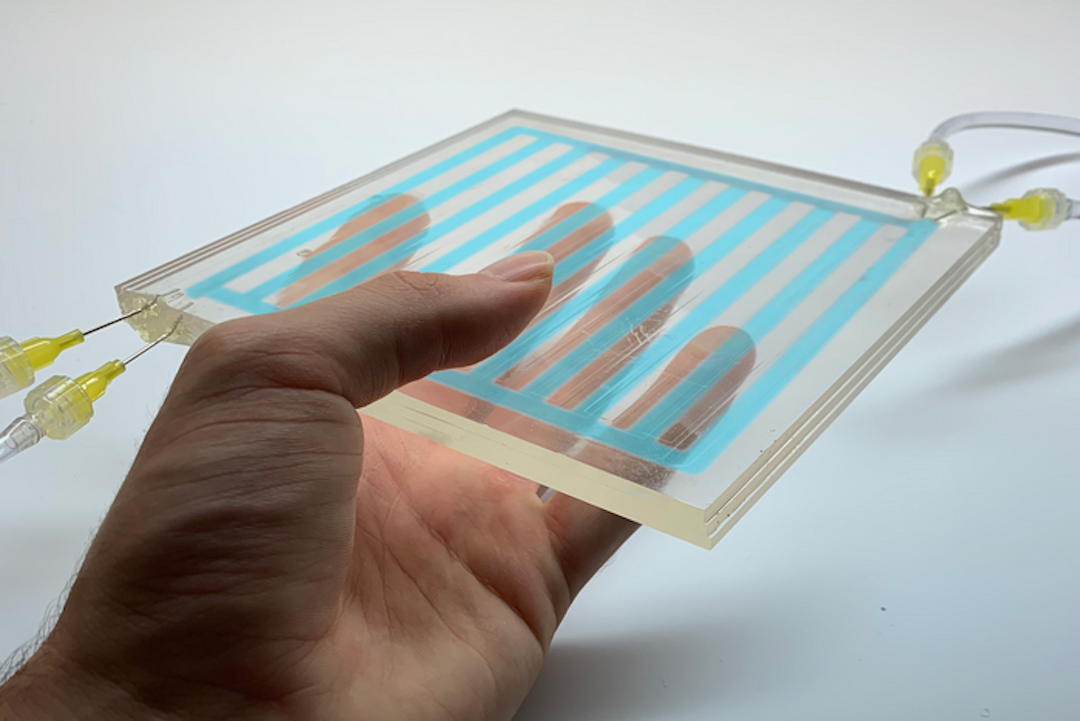
Scientists at the University of Toronto have developed an innovative window system—inspired by the squid—designed to reduce energy consumption and the costs of heating, cooling, and lighting buildings.
According to Interesting Engineering, these multilayered ‘liquid windows’ optimize the wavelength, intensity, and dispersion of light coming in through the glass, allowing for solar energy to be strategically controlled.
Most buildings use copious amounts of energy to light up, heat, or cool interiors all the time. Much less power would be required if we were able to tweak the amount, type, and direction of sunlight entering at any given moment.
As the researchers pointed out, while we have “smart” blinds or windows these days, those systems remain limited, as they cannot differentiate between the different wavelengths of light or control how it disperses.
The new prototype—made out of flat plastic sheets with ultra-thin channels through which fluids can move—allows for customized pigments, particles, and other compounds to control the type of light that passes through the windows, and the direction in which the rays are distributed.
Furthermore, each sheet can be stacked atop another in a multi-layer formation, with each layer responsible for controlling a different component of the light filtering indoors.
Interestingly, this design was inspired by several species of squid. These creatures have skin with layers of organs, including ones that control light absorption and reflection, that work together to create “unique optical behaviors.”
The team explained that with just one sheet that modulates the transmission of near-infrared light, buildings could save up to 25% annually on energy use. Two layers, controlling both infrared and visible light, could save up to 50% in total.
Going forward, the researchers plan on using artificial intelligence to optimize the layers and which components of light they control for the best results. In fact, these settings can even be changed based on seasonal and daily conditions.
“The idea of a building that can learn, that can adjust this dynamic array on its own to optimize for seasonal and daily changes in solar conditions, is very exciting for us,” explains Raphael Kay, lead author of the recently-published paper.
[via Interesting Engineering and EurekAlert, cover image via Raphael Kay, Adrian So / EurekAlert]


