
This AI-Created Picture Just Clinched Top Prize At A Photography Contest
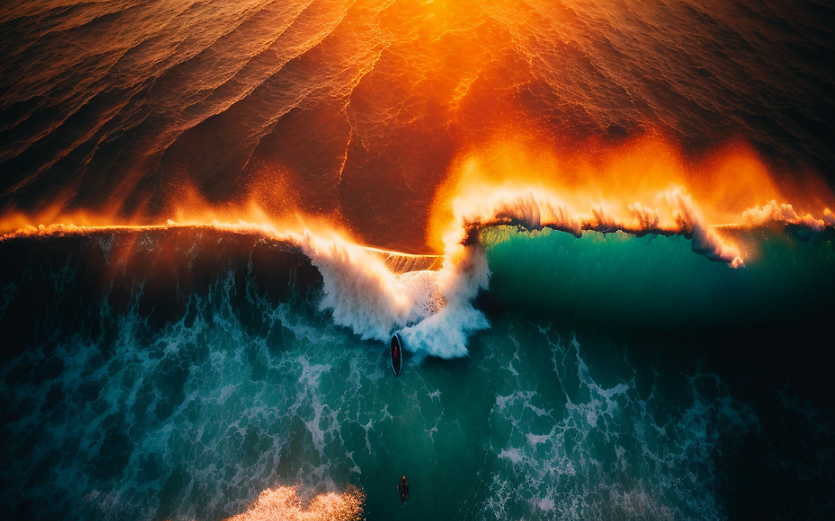
A pair of surfers were lensed from above rushing up to a wave at sunrise. The opportune time created a spectacular image of cyan and orange—the contrasting hues split into a near-perfect half. Isn’t Mother Nature beautiful?
The drone shot, credited to one “Jane Eykes,” won first prize at the Summer photography contest held by Australian electronics firm digiDirect, which hosts such events every week. Alas, everything about the image is fabricated—even the beach. The “photographer” too.
Soon after the company announced this round’s winner, an AI art studio called Absolutely Ai stepped forward and admitted it was behind the picture, which it had created from its couch in Sydney.
View this post on Instagram
“We did it to prove that we’re at a turning point with artificially intelligent technology by passing the ultimate test,” Absolutely Ai explains. “Could an AI-generated image not only slip by unnoticed… but actually be awarded the top prize by a photography expert?
“The answer is, resoundingly, yes,” the studio affirms.
Absolutely Ai says it reached out to the contest’s organizers to return the cash prize after learning it had won the photography contest.
The made-up photographer’s name was, in fact, a nod to the 15th-century painter Jan van Eyck, whose Adoration of the Mystic Lamb work is billed as the “most stolen work of art” of all time.
Jamie Sissons, one of Absolutely Ai’s founders, shares that the faux-tograph was generated from a single text prompt.
Although critics have pointed out the shot’s unusual wave pattern, the team predicts that, with the meteoric rise of AI technology, there could be a day when it’s impossible to tell if a photo is genuine or instantly fashioned by a machine that was trained on billions of images.
Sissons tells news.com.au that he’s won photography and filmmaking awards, but “my stuff doesn’t look as good as what a machine can generate.”
The stunt follows a similar incident from September, when an AI-generated work won a fine art contest in Colorado. However, this is the first time a machine has been selected as the winner of a photography contest, PetaPixel reports.
Such cases illustrate the sweeping impact of a disruptive technology, where the only thing a creator needs to do is wake up and have a thought. Sissons explains in an article on Australian Photography that the team didn’t have to get up at unearthly hours to drive to the beach and take a drone above the sea at sunrise. Instead, the image was created “by entering text” into an art generator “from our couch in Sydney.”
“We’re still very early in the development of these AI image generators. Within one year, five years, they’ll be much better again,” Sissons details in an interview with DesignTAXI. Eventually, it may be impossible for experts to look at a picture and recognize that it is AI-generated, Sissons adds.
Asked how art and photography competitions may reassess their processes to weed out AI images, Sissons posits: “These ‘fake’ images obviously don’t have the same metadata that real photographs do.” As such, the best way for contests to catch such instances of cheating, for now, “is to check the metadata on every entered image.”
“I’m not sure if there are also tools being developed that can detect an AI image—I’d imagine there eventually will be,” Sissons shares with DesignTAXI.
As for the image at hand, Absolutely Ai has titled it The Most Stolen Photograph. You can follow the studio on its website and Instagram to watch its other experimentations with the burgeoning world of AI art creation.
View this post on Instagram
[via PetaPixel and The San Francisco Standard, images by Absolutely Ai and featured with permission]


