
NASA’s Curiosity Rover Catches Mars’ Iridescent Sun Rays For The First Time
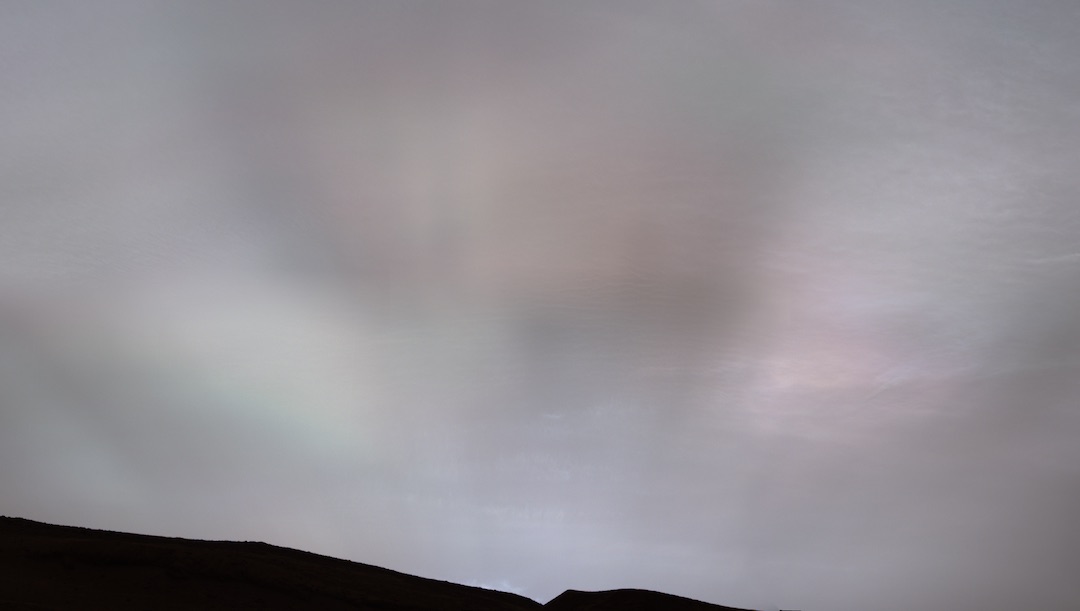
In early February, NASA’s Curiosity Rover witnessed a stunning display of Sun rays bursting through the clouds on Mars. As part of its mission to study the atmosphere on the planet, it snapped some images with its Mastcam of the ethereal display of light.
Curiosity took a panorama—28 images stitched together—of the crepuscular rays before sending it back to Earth. The pictures were to aid scientists in gaining a better understanding of what the weather is like on Mars and give space enthusiasts a glorious look into what the Sun’s light would look like if they could stand on another planet.
Well, this is a first... ðŸ˜
— Curiosity Rover (@MarsCuriosity) March 6, 2023
As I watched the sunset last month, I captured something spectacular: My team says these are some of the most clearly visible images of sun rays we've ever seen on Mars! pic.twitter.com/HIgzZHdAyV
The rover is currently taking images of the sky on Mars as part of NASA’s twilight cloud survey. The project began in 2021 when noctilucent clouds were being studied to understand the atmosphere on the Red Planet.
Typically, clouds on the planet are rarely higher than 37 miles off the ground which has scientists believing they are made out of dry ice rather than water ice. Noctilucent ones, on the other hand, tend to rest higher in the sky in colder altitudes. In gathering data for researchers back on Earth, Curiosity has previously taken black-and-white images to allow NASA’s team to track its structure in motion.
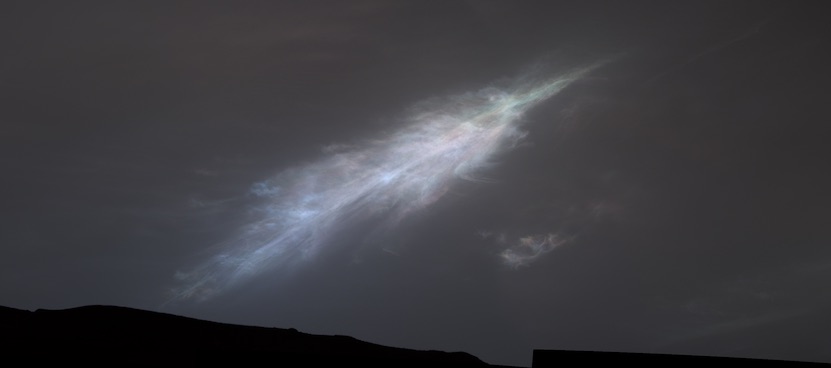
However, color images are needed to distinguish the composition of particles as they grow in number. In another instance, Curiosity had also caught a feather-shaped iridescent cloud as the Sun set on Mars. “Where we see iridescence, it means a cloud’s particle sizes are identical to their neighbors in each part of the cloud,” said Mark Lemmon, a planetary scientist at the Space Science Institute. “By looking at color transitions, we’re seeing particle size changing across the cloud.”
[via Futurism and PetaPixel, images via NASA/JPL-Caltech/MSSS]


