
Scientists Create ‘Vocal Cords On A Chip’ To Help Mute Persons Find Their Voice

One may either be a big fan or wary of artificial intelligence, as the technology hits the mainstream with its never-ending list of chatbots and generators. But what if scientists could use the tool to help persons living with disabilities?
That’s the plan behind a project by researchers at Tsinghua University in Beijing, China, who worked on a simple device that the team claims can give speech back to those who have lost their voices due to an illness or injury.
According to the National Institute On Deafness and Other Communication Disorders, an estimated 17.9 million adults in the United States reported having an issue with their voice in the last year.
Now, they’ll be able to use the new tool—measuring just one-centimeter square (0.0010 square foot)—by attaching it to the throat, transforming barely audible whispers into clear, audible speech.
Currently, voice-disabled patients sometimes have microphones attached to their bodies to help them communicate, though the solution remains clunky and difficult to set up and manage.
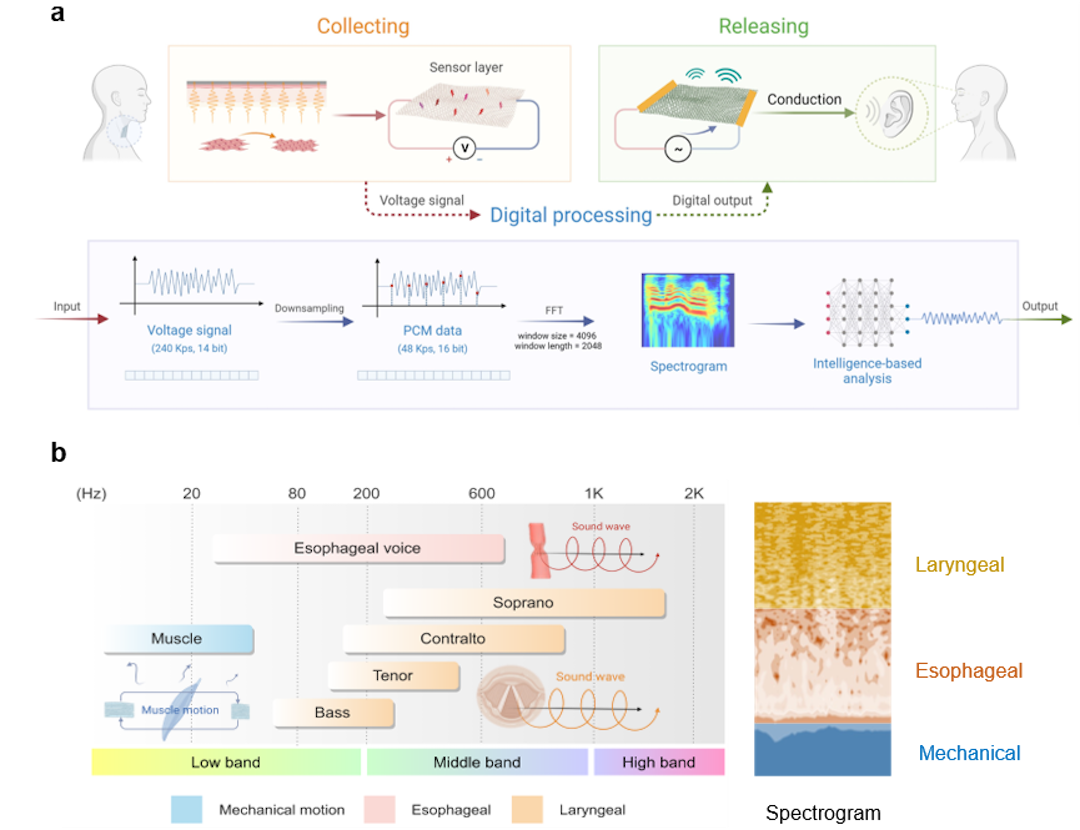
As per TechXplore, team leader Professor Ren Tianling explained that the chip, which works on an AI model, helps to interpret sounds and bodily vibrations emitted by the wearer to form vocalizations.
In fact, the scientists are confident the voice fabrication process is a “promising tool” for future speech recognition systems. The chip’s graphene sensors make it the perfect material to detect tiny vibrations on the skin’s surfaces.
Furthermore, the team took care to engineer the tool so that interference from the surroundings, such as highways, parties, or other loud sounds, does not affect the device as it continues to function similarly regardless of the environment.
Moving forward, the researchers will be conducting more studies to bring more expressiveness and vocalizations to the chip, though they believe it’s a practical and efficient enough device to be used on a larger scale in the future.
[via Interesting Engineering and TechXplore, images via various sources]


