
‘Carpet’ Of Solar Panels Unrolls Itself Along Swiss Railways

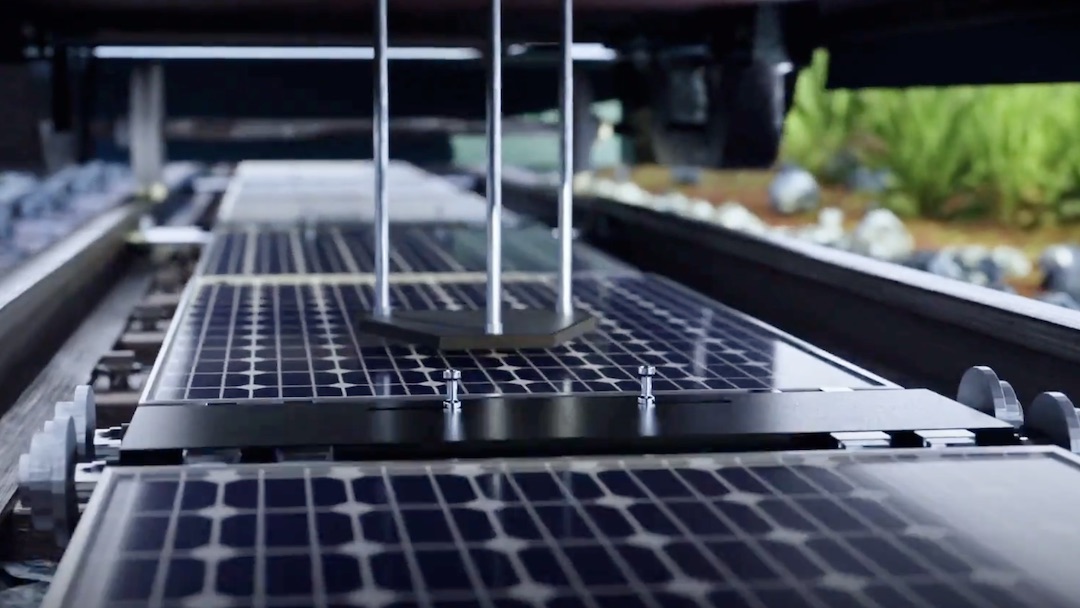
Did you know that train tracks could be the perfect location for solar panels? Swiss company Sun-Ways certainly thinks so! It’s unrolling a carpet-like network of photovoltaic cells over rail lines to capture energy for trains, stations, and other facilities along the route.
Solar panels play a big role in producing sustainable energy. However, they’re often big and take up a lot of space. Railways are a viable option because the width of the tracks is just right for the cells.
An upkeep train from the company Scheuchzer positions the 3.3-foot panels into place and fastens them with a piston mechanism. As it installs them, it unfurls like a carpet. This allows for them to be easily moved during maintenance, unlike other systems along railways that are permanently embedded. Their power will then be channeled into the surrounding power grid.

The concept has been patented in partnership with the Swiss Federal Technology Institute in Lausanne.
According to swissinfo.ch, which broke the story, Baptiste Danichert, co-founder of Sun-Ways, noted that using the railways provides an outlet that will not disrupt the environment. The report states that there are strict rules for protecting the environment and cultural heritage, which prohibit solar cells from being set up on private buildings, infrastructure, and mountaintops.
However, there are a couple of caveats. The International Union of Railways is concerned that microcracks might form in the cells and spark forest fires or cause conductors to be distracted by the reflection of its surface. In response, Sun-Ways notes that its panels are more durable than conventional ones.
Sun-Ways claims its system can be installed on around 50% of the over a million kilometers of railway lines worldwide. However, the company is currently focusing on train networks in Western Switzerland.
According to the company, Switzerland’s national rail network has the potential to generate around one Terawatt-hour (TWh) of solar energy every year. This would be equivalent to roughly 2% of the country’s total electricity consumption. With such a contribution to the energy mix, photovoltaic panels on railway tracks could play a key role in reducing carbon emissions and transitioning towards a more sustainable future.
[via Interesting Engineering and TechTimes, screenshots via Sun-Ways]


