
Soft Robot That Crawls Like A Caterpillar Can Slip Its Way Under Doors
Previously, a team at the IIT-stituto Italiano di Tecnologia developed a robot in the shape of an earthworm, drawing inspiration from the insect to create a machine that is able to fatten up and slim down on demand to accommodate the space it’s in.
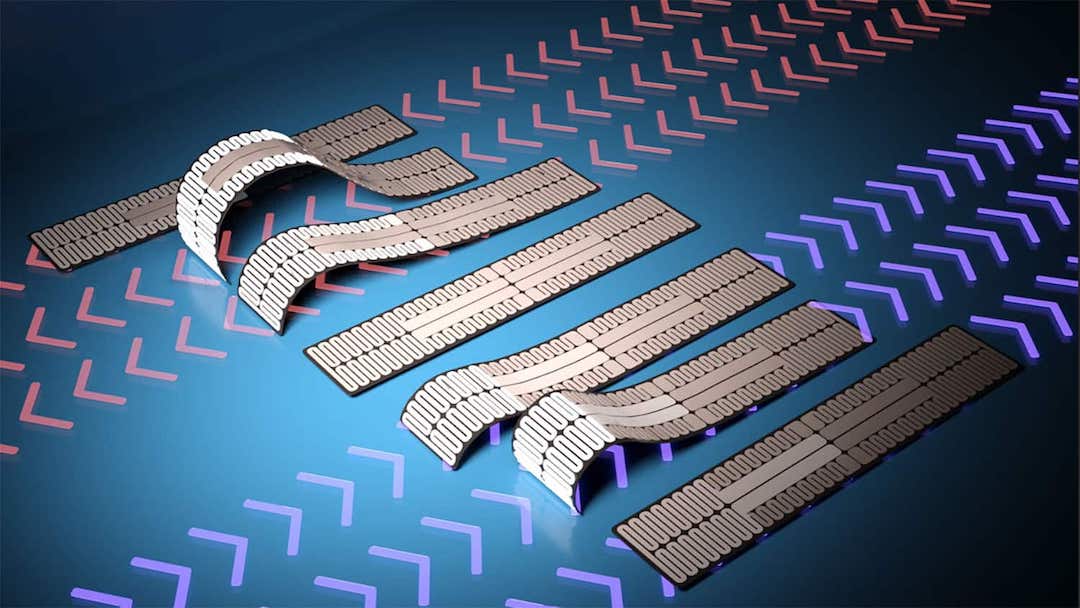
Now, engineers at North Carolina State University have come up with a soft robot in a similar vein—this time mimicking the movement of a caterpillar, allowing the energy-efficient tool to move forward, backward, and ease into narrow spaces.
According to researchers, the caterpillar-like robot has its movements controlled by a novel pattern of silver nanowires, which heat up and cool down to bend the device in order for it to be steered in different directions.
The team tapped into the caterpillar's biomechanics, in which its movement is controlled by the local curvature of its body, to construct the nanowire heaters that enable the robot counterpart to move similarly.
“Engineering soft robots that can move in two different directions is a significant challenge in soft robotics. The embedded nanowire heaters allow us to control the movement of the robot in two ways,” explained author Yong Zhu.
“We can control which sections of the robot bend by controlling the pattern of heating in the soft robot. And we can control the extent to which those sections bend by controlling the amount of heat being applied,” he added.
To achieve this, the crawling robot is made up of two layers of polymer—both of which respond differently when exposed to heat. The bottom layer contracts or shrinks while the top layer expands when an electric current is applied, enabling it to pull itself forward or push backward.
The scientists found that the more current that was applied to the gadget, the faster it could move in either direction. However, there was an “optimal cycle” the team settled on that gave the polymers enough time to cool and “relax” before moving again.
Even more impressively, the researchers successfully demonstrated that the robot could be steered into small openings, such as the gap under a door, showing that it could be manipulated to bend and ease into tight spaces at any time.
Going forward, the team is exploring ways that the robot could become more efficient, and is looking to integrate the device with sensors or other technologies so it could one day be used in various ways, such as search-and-rescue devices.
[via InceptiveMind and Institution of Mechanical Engineers, cover image via North Carolina State University]


