
Art Of Origami Inspires Scientists In Developing 3D Folding Glass
Origami is the Japanese art of paper folding, which involves transforming a flat sheet into a beautiful object. It has a long and rich history, dating back to the 17th century when it was primarily used for religious and ceremonial purposes.
Such delicate creations have since inspired Yang Xu and Professor Tao Xie at Zhejiang University to concoct a new form of making glassware that involves folding glass instead of 3D-printing or blowing it.
This new method first mixes nanoparticles and silica into a solution of liquid polymer and other compounds. Then, when exposed to ultraviolet light, the solution transforms into a solid cross-linked polycaprolactone polymer, which looks like silica beads suspended.
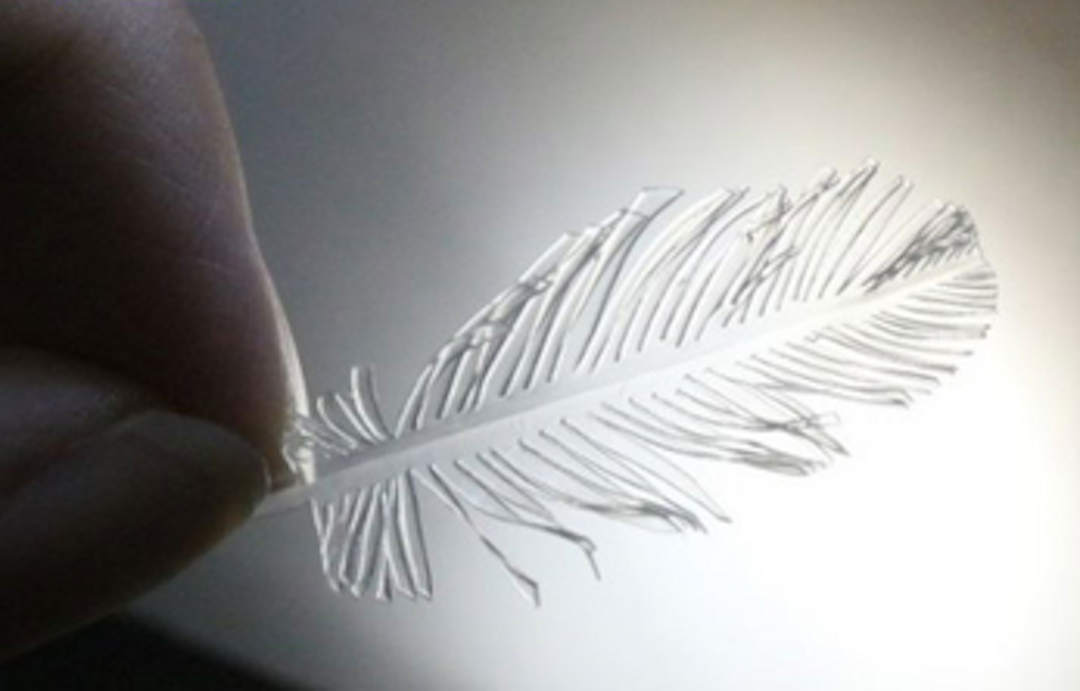
It is then cut into flat translucent sheets with the same mechanical properties as paper. It can be folded, twisted, and pulled into shapes, like a crane or a feather.
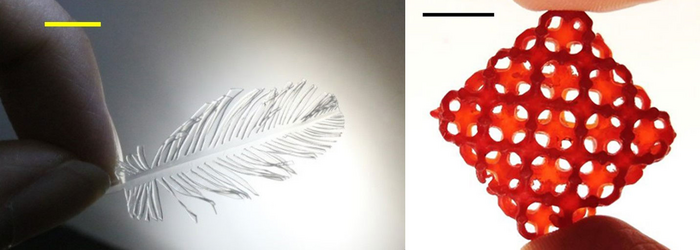
The team found that when the sheets were heated to 265°F, the links between the polymer chains were permanently rearranged, and they could hold their exact shape throughout the process.
They were then warmed again to 1,100°F to ensure the polymer melted away and left an opaque object. Finally, it was heated for one last time at a temperature of 2,300°F before it emerged in a smooth and transparent form.
The team suggests this method is faster than 3D-printing or glass molding and can create more complex designs.
Next up in the researchers’ study is to see if such a method can be used to manipulate ceramic objects by replacing the silica particles with titanium dioxide and zirconium dioxide.
Xu and Xie will present the findings to the American Chemical Society in the spring.
[via New Atlas and American Chemical Society/EurekAlert, images via Yang Xu/American Chemical Society via EurekAlert]


