
James Webb Captures ‘Cosmic Seahorse’ Image Of Gravity Bending Spacetime
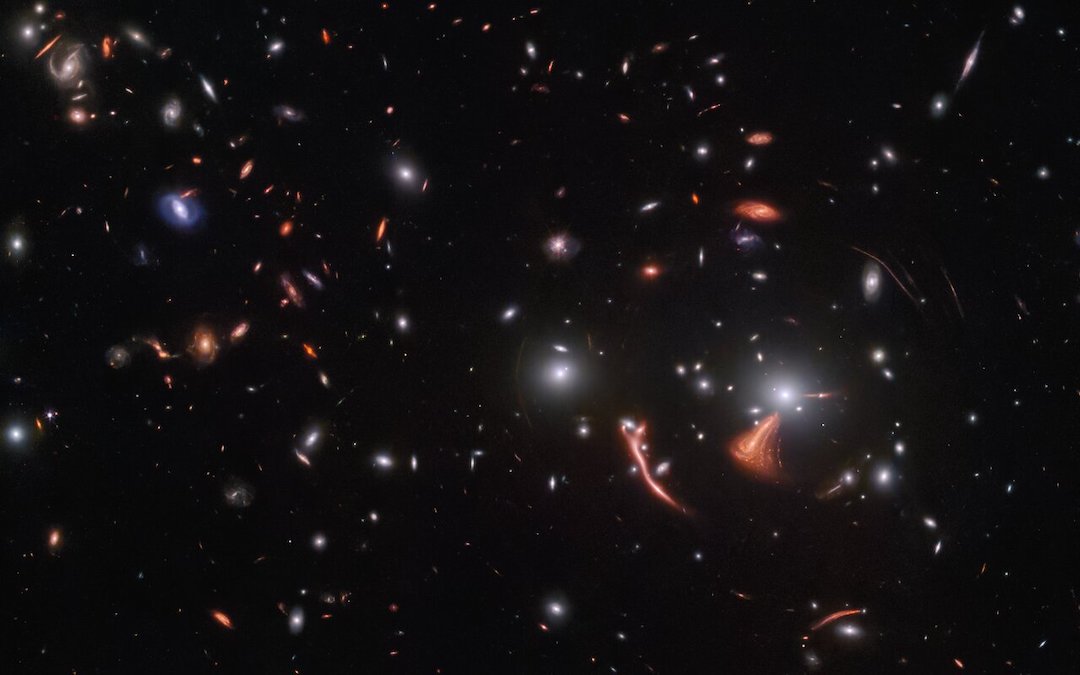
The universe is full of strange and wondrous sights, and the James Webb telescope has just captured one of the most breathtaking yet—a ‘Cosmic Seahorse’. This stunning image depicts a cluster of galaxies bending and warping in the space-time continuum, 6.3 billion light-years away from our humble little planet.
The image of SDSS J1226+2149 shows a group of planetary systems that are so massive that they’re causing the space around them to warp and bend. This is shown through the gravitational lensing effect causes an elongated and exaggerated shape, much like the majestic seahorse.
“This effect, referred to by astronomers as gravitational lensing, occurs when a massive celestial object such as a galaxy cluster causes a sufficient curvature of spacetime for light to be visibly bent around it, as if by a gargantuan lens,” explains the European Space Agency.
Gravity is a powerful force that can distort space, creating an “optic” that channels light toward a telescope. This allows scientists to peer into the deepest, darkest corners of the universe and to study the formation of new stars in distant galaxies.
The red crest-like shape in the image is the Cosmic Seahorse, and it’s giving astronomers an unprecedented look into this galaxy and the star formation that’s taking place within it. This photo is just one example of the James Webb telescope’s incredible work to expand our understanding of the universe.
As Webb continues exploring the cosmos, astronomers eagerly anticipate the insights it will provide into star formation in distant galaxies. With its crystal-clear vision and cutting-edge instruments, the ESA believes that the James Webb telescope is poised to reveal even more wonders of the universe that we have yet to imagine.
[via Mashable and PetaPixel, cover image via ESA/Webb, NASA & CSA, J. Rigby]


