
This Sprawling High-Tech Innovation Park Could Become Europe’s AI Silicon Valley
Until now, there hasn’t been a European equivalent of California’s Silicon Valley. That could change, as the German region of Heilbronn will soon welcome a high-tech innovation space, centered around artificial intelligence, that could propel it to the forefront of technology.
Minds at architecture firm MVRDV have come up with the design for the Ipai Campus, which involves a sprawling, circular campus spanning over 265,000 square miles. The site will house laboratories, buildings for scientific research, and a startup hub.
In addition, facilities including housing, restaurants, a kindergarten, a skatepark, and a running track will be made available to occupants. That’s not all, as with most structures created in this day and age, the structure will boast solar- and wind-powered eco-friendly features.
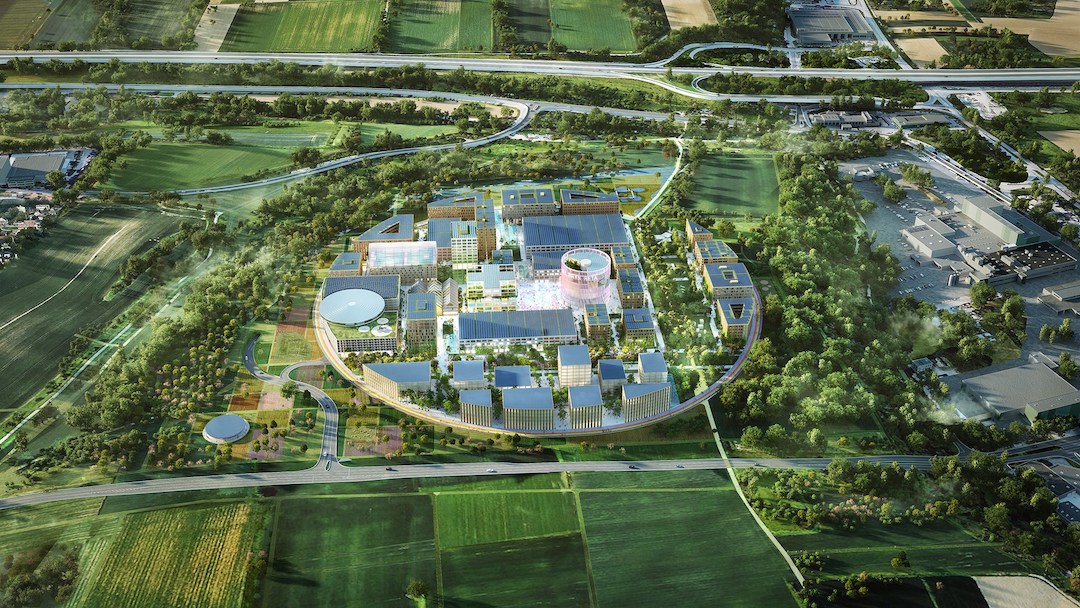
According to the designers, for the Heilbronn site to compete with technology hubs across the world, it needed a “bold, recognizable gesture.” This led to the decision to lay out the buildings in a circle, making the site an instantly-recognizable symbol even in satellite images.
Across the space, most of the buildings will take on a simple rectangular form with a consistent height of 27 meters (88.5 feet), allowing for efficient construction using modular grids and environmentally friendly, bio-based materials.
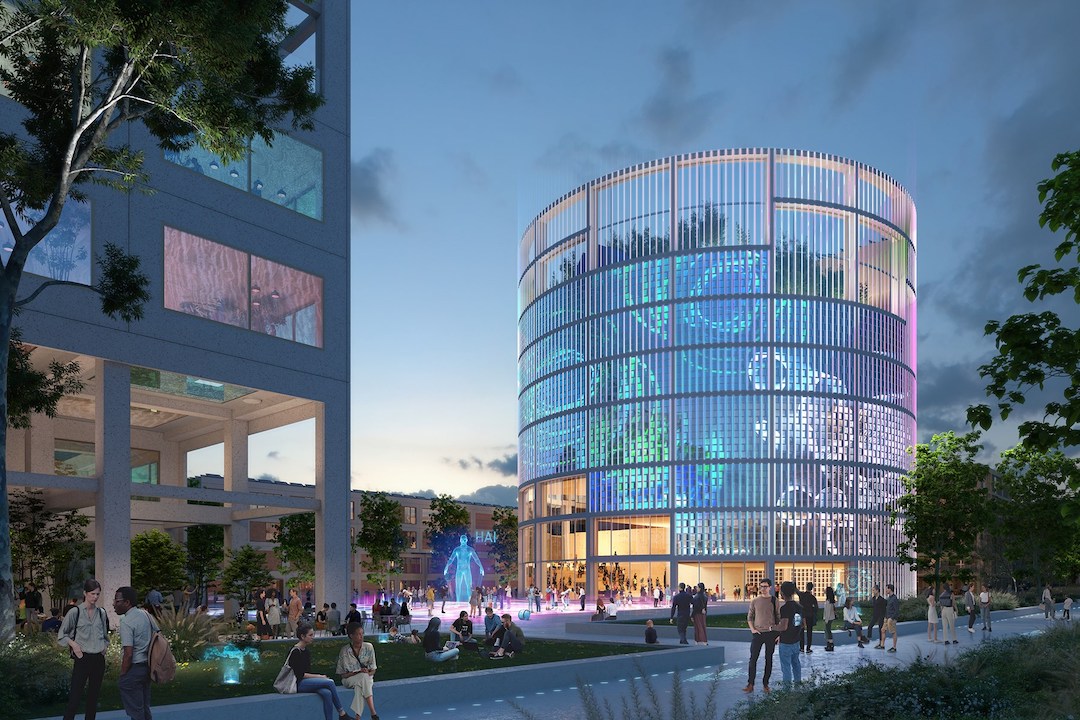
Of course, its center will feature several “special” stand-out buildings, incorporating “unique typologies, iconic forms, and taller structures” that will shape the campus’ skyline. The most notable will be a round tower on the central plaza that acts as a point of contact with the public.
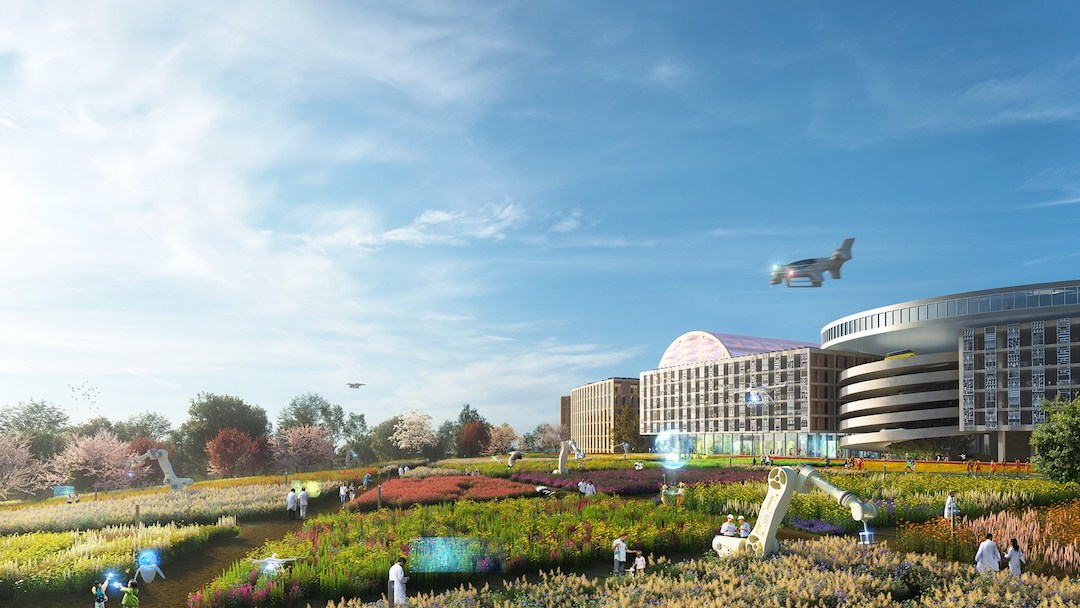
Interestingly, the site was designed to be compact so that a large portion of the region could be used to integrate with the natural landscape. Forests, orchards, and meadows will be grown in the area, serving as test beds for biodiversity- and agriculture-related projects.
These green spaces will help lower the overall carbon footprint of the campus, which is predicted to be 80% lower than a typical site of the same size. Its buildings will be fitted with bioclimatic façades and energy-efficient services to minimize energy required to run the various structures.
Furthermore, renewable energy will be produced locally by way of wind turbines and solar panels, with the excess power stored using batteries in ground-based heat and cold storage. In all, the hub expects to be 100% carbon-neutral across the course of its lifespan.

“The developments we have seen recently in the field of AI demand the attention of people from all walks of life, and with this design we create a compact campus for this to happen,” explained MVRDV Founding Partner, Jacob van Rijs.
“The striking form of the campus can help to propel it to an international stage, attracting world-class talent. Meanwhile, the welcoming and engaging atmosphere, even the recognizable appearance, make this place a destination where people can engage in the future of this technology.”


