
James Webb Telescope Flashes Uranus’s Nearly Invisible Rings In Stunning Pics

“This zoomed-in image of Uranus, captured by Webb’s Near-Infrared Camera (NIRCam) on 6 February 2023, reveals stunning views of the planet’s rings. The planet displays a blue hue in this representative-color image, made by combining data from two filters (F140M, F300M) at 1.4 and 3.0 microns, shown here as blue and orange, respectively.” Image via NASA, ESA, CSA, STScI. Processing: J. DePasquale (STScI)
Uranus looks to be blinged-out in remarkable new images captured by the James Webb telescope.
Thanks to its ability to process infrared wavelengths, Webb prominently picked up the ice giant’s rings, which are barely visible in the optical wavelength observed in other telescopes like Hubble, Digital Trends points out.
The graphic you see here is the result of a 12-minute exposure taken on February 6, when Uranus was 1.83 billion miles away from our home planet.
The icy planet has 13 known rings comprising dust and small moons, and 11 of them can be seen in the image.
The small moons are too faint to be visible in the picture, but you’ll be able to catch sight of the six more distant moons in the surroundings, each one interestingly named after characters in works by Shakespeare and Alexander Pope: Puck, Ariel, Miranda, Umbriel, Titania, and Oberon.
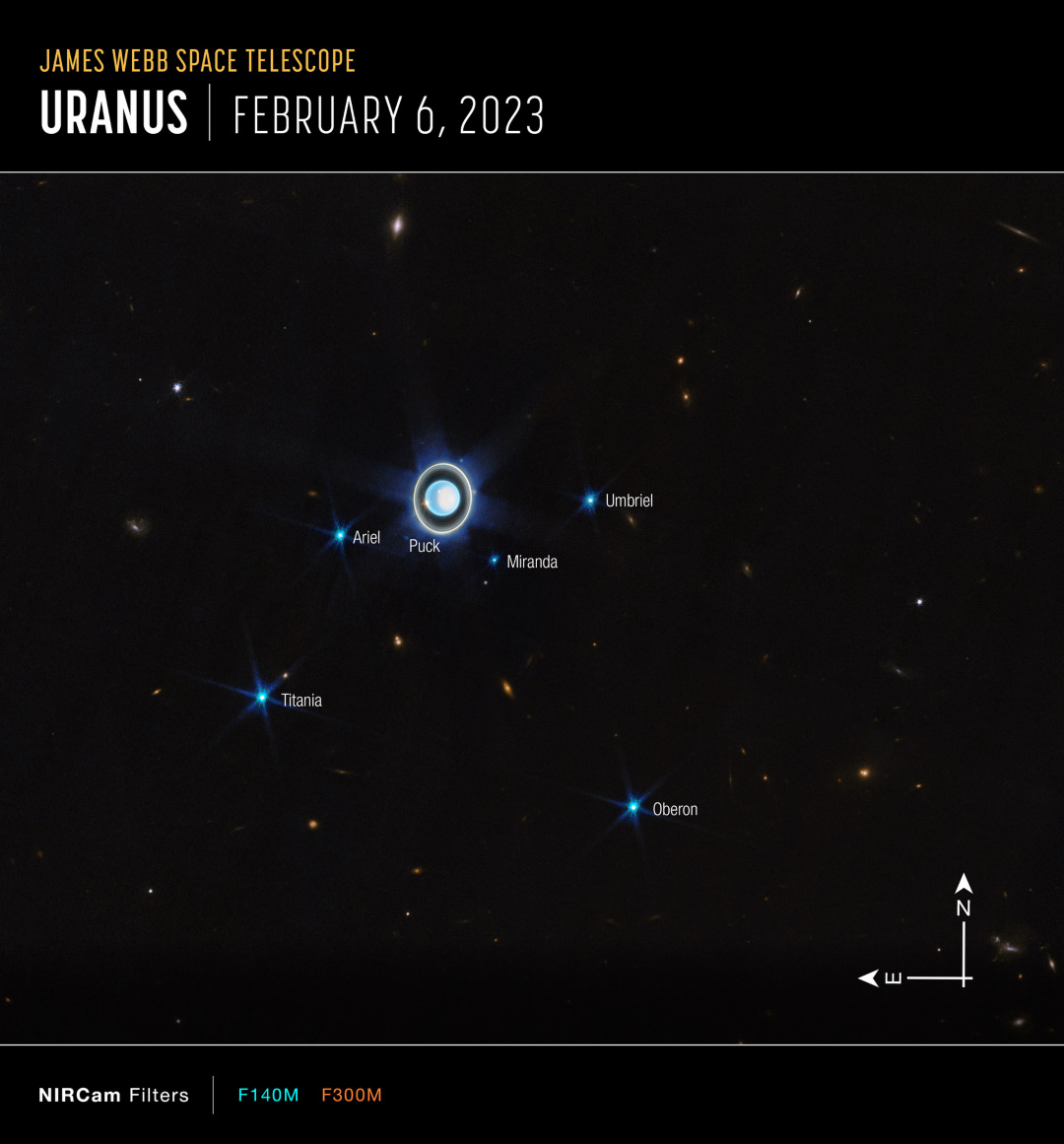
Uranus stands out from the other planets with its complete tilt, its axis laying at 98 degrees. During the northern summer, the sun beams right into the celestial body’s north pole and doesn’t set, which explains the apparent polar cap, distinguished by a white blob, on its right.

[via Digital Trends and Gizmodo, images via NASA, ESA, CSA, STScI; processing: J. DePasquale (STScI)]


