
UAE’s Hope Spacecraft Presents Incredible Close-Ups Of Mars’ Elusive Second Moon
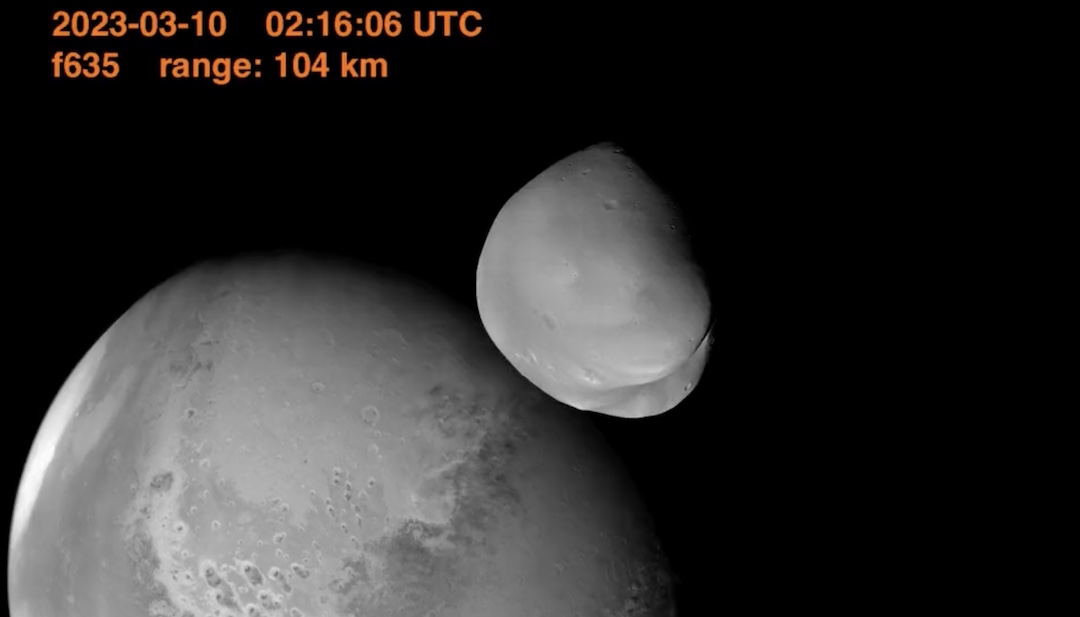
Deimos is the second moon in Mars’ orbit and has often been thought to be an asteroid caught in the belt of the planet’s pull. However, the United Arab Emirates Space Agency has just flown its Amal, or Hope, probe close enough to an elusive celestial object and revealed what might have been a more violent origin.
Deimos is just 9 x 7 x 7 miles wide and is oddly shaped like a potato thanks to its many craters that have created dips and valleys so large and wide on its surface. The main moon, Phobos, and Deimos were too small for gravity to cast them into proper spheres, hence their more organic form.
ÙÙŠ سابقة عالمية جديدة … مشروع الإمارات لاستكشا٠المريخ "مسبار الأمل" يقترب لمساÙØ© ١٠٠كم من القمر التابع للمريخ "ديموس" .. ويلتقط Ø£ÙˆØ¶Ø ØµÙˆØ±Ø© Øصل عليها البشر لهذا القمر …
— HH Sheikh Mohammed (@HHShkMohd) April 24, 2023
تخبرنا النظريات بأن هذا القمر هو كويكب خارجي تم التقاطه ضمن مدار المريخ .. ويدØض مسبار الأمل هذه النظرية… pic.twitter.com/JDOy1fpn6B
In addition, Deimos orbits Mars 14,580 miles from the Red Planet, much further than Phobos at just 3,700 miles. This significant distance put it in Amal’s pathway and made it a desirable target for the mission to study.
With new photos and information on the object, new theories have emerged that give us a better understanding of Deimos’ origin. The moon’s surface comprises the same rock that makes up the Martian crust. So it’s thought to have been a chunk of the Red Planet that might have been blasted into its orbit after an asteroid smashed into it.
Adding high-quality data to the relatively sparse collection of spacecraft observations obtained over the past 50 years. On 10 March 2023, EMM passed within some 100 km of Deimos, with EXI capturing images throughout the flyby. pic.twitter.com/hytuzqp4Sy
— وكالة الإمارات للÙضاء (@uaespaceagency) April 27, 2023
Another theory posits that both moons could have been made up of rubble that Mars had pulled in, blasted from an asteroid collision, or both. The mix of cosmic rock could also be why Phobos and Deimos are shaped as such.
Amal will continue its journey in close orbit to Deimos as it learns more about the moons and the Martian atmosphere.
[via Inverse and PetaPixel, cover image via UAE Space Agency]


