
Commercial Craft Flying At Super Speed Could Get You From NY To Tokyo In An Hour
Whether you hate or love it, part of traveling is being crammed onto a squeezy plane and spending several hours getting from one destination to the next. If you were eyeing a trip from the New York to Tokyo, you might be in for a 14-hour nonstop ride.
But what if you could get there in an hour?
Yes, just one hour. Of course, for that to happen, you’ll be zooming across the planet at Mach 9, which is nine times greater than the speed of sound. The fastest airplane built is Lockheed’s SR-71 Blackbird, which can reach Mach 3.2. Ars Technica points out that anything above Mach 9 would cause an aircraft to lose communication with the ground as plasma begins to encase the vehicle—a somewhat scary thought if you were just a regular person trying to kickstart your holiday.
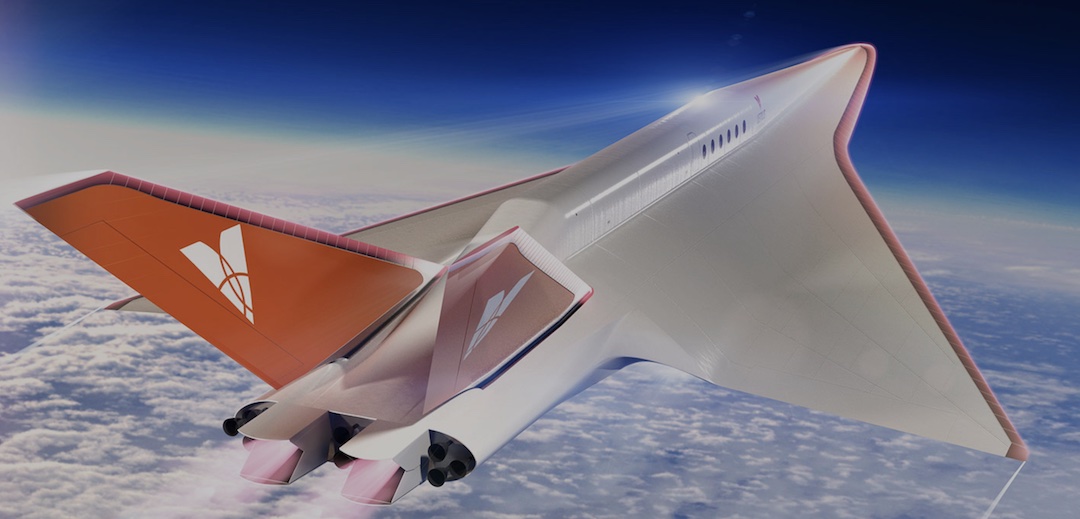
Texas-based Venus Aerospace is looking to change that. The incoming ‘Stargazer’ plane is about to achieve the unachievable and fly between cities at a speed no average person has yet felt. It’s doing so by employing something known as the ‘rotating-detonation concept’. This method has been in the works for many years now as it could increase fuel efficiency and aid military purposes.
The main difference between that and a typical jet is that in a regular rocket engine, a highly pressurized fuel and oxidizer are pumped into a combustion chamber and burned to produce exhaust plumes. The rotating detonation engine, in comparison, exudes a wave of detonation around a circular channel. An injection of propellant and oxidizer sustains this and produces a shockwave that travels outwards at supersonic speed. Venus Aerospace is also looking at a mix of fuel types, including room-temperature hydrogen peroxide and Jet-A, which most jet aircraft use at airports.
The company aims to send the Stargazer to take off and then take a 10-minute boost before blasting off into the atmosphere about 31 miles up—or halfway to space. The plane won’t exactly make it to the stratosphere or the Karman line, the boundary between the atmosphere and the rest of the galaxy, but it will be able to see the planet’s curvature.
On top of this, it also aims to transport 12 passengers on four daily flights, just like other passenger airlines.
Now, you won’t be able to just hop onto one of these flights soon; the Stargazer is very much still in testing. Per Robb Report, the company has just started using a 20-foot drone for hypersonic flight testing to see if it can reach Mach 5. After that, a Stargazer prototype will go into production, though no timeline has been given on when that will be.
[via Robb Report and Ars Technica, images via Venus Aerosapce]


