
Notre Dame Cathedral’s Roof Is Being Put Back Together Using Medieval Techniques
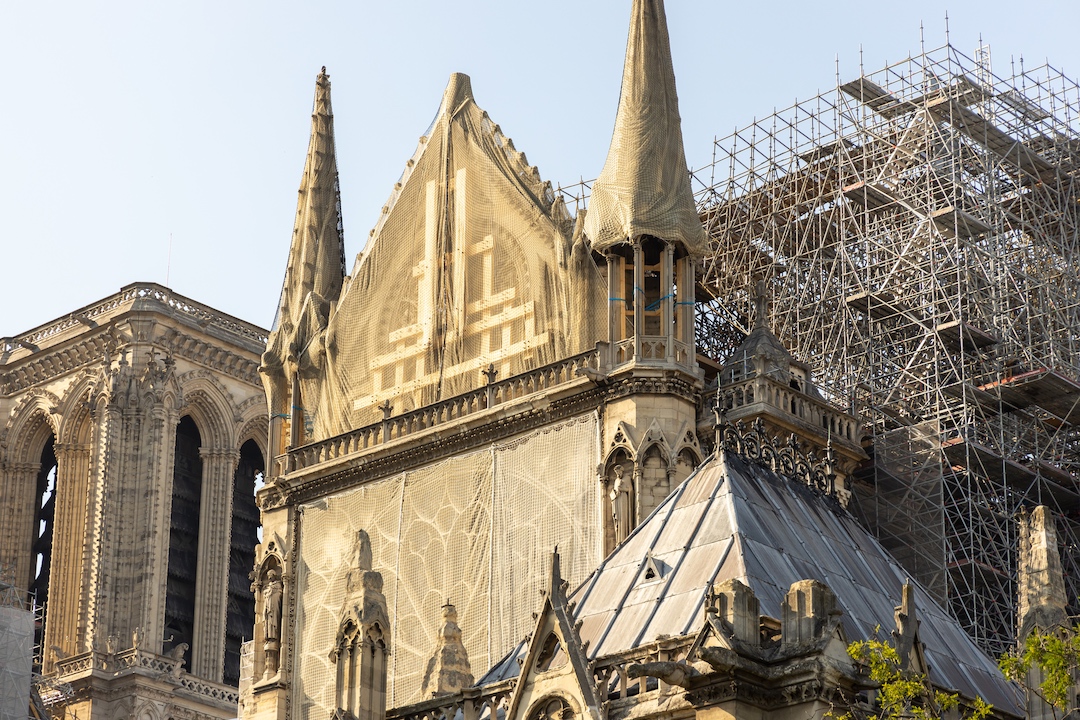
Earlier this year, French authorities admitted that the Notre Dame Cathedral, which has been undergoing renovations since it was engulfed in a blaze, may not be restored in time to welcome visitors during the 2024 Olympic Games in Paris.
Interestingly, as builders busied themselves with restoring the famed landmark as quickly as possible, it was discovered that an analysis of the site showed that the building may have been the first Gothic cathedral of its time to use iron reinforcements throughout its structure.
Now, four years on from the tragic disaster, architects have revealed that the fire-ravaged roof is being pieced back together using special medieval-era techniques so as to ensure the crown of the monument is restored as close to its original form as possible.
Builders have the back-breaking task of using hand axes to fashion hundreds of tons of oak beams for the roof’s framework in what the Associated Press described as a process that seems akin to “rewinding time.”
Peter Henrikson, one of the carpenters on site, told the publication that having to manually strike a mallet on a chisel makes him contemplate how workers 900 years ago were hard at work cutting “basically the same joint.”
Notre-Dame update!
— Elodie's Paris (@Paris_by_Elodie) June 1, 2023
The 4 first timber roof trusses have been brought up, they will soon be followed by more to form the base of the spire and later on the roof of the cathedral.
It’s fascinating to watch it come together!#NotreDame pic.twitter.com/Zh3ar8g33K
Of course, there are lots of quicker ways to construct buildings. The use of medieval techniques is a deliberate choice—in hopes of paying homage to the incredible craftsmanship exhibited by the landmark’s original builders and replicating the art of hand-fashioned wood.
Despite the tight deadline looming overhead, Jean-Louis Georgelin, a retired army general who is overseeing the project, emphasized the importance of restoring the cathedral “as it was built in the Middle Ages” in a way that was faithful to the handiwork of those who first constructed it.
Fortunately, just last month, the reconstruction reached a significant milestone when most of the roof’s timber frame was assembled and erected at a workshop. Soon, the actual parts will be installed atop the monument, just that this time, there’ll be cranes to lift it into position.
There’s certainly something to be said about how steadfast the builders are in adhering to the cathedral’s architectural history. As architect Remi Fromont put it, by using the same materials and tools, the roof will soon “return to its same place.”
[via Interesting Engineering and Associated Press, cover image via Martin Helgemeir | Dreamstime.com]


