
Yale’s Free Lux ‘Search Engine’ Lets You Delve Deep Into Its Storied Archives

Those in search of greater knowledge can now dive deeper into the extensive museums, archives, and libraries of Yale University with Lux, the institution’s free “search engine” hub.
With 17 million searchable objects, the tool works by building relationships between objects users look up, uncovering how it relates to other items within the university’s storied collection no matter how distant it may seem.
Users can explore the Yale Center for British Art (YCBA), the Yale University Art Gallery, the Yale Peabody Museum, and Yale University Library, which includes the Beinecke Rare Book and Manuscript Library and the Lewis Walpole Library.
“Lux is designed to open the breadth of Yale’s cultural and natural history collections, connecting our wide range of extraordinary objects, specimens, and works,” said Susan Gibbons, Vice Provost for Collections and Scholarly Communications.
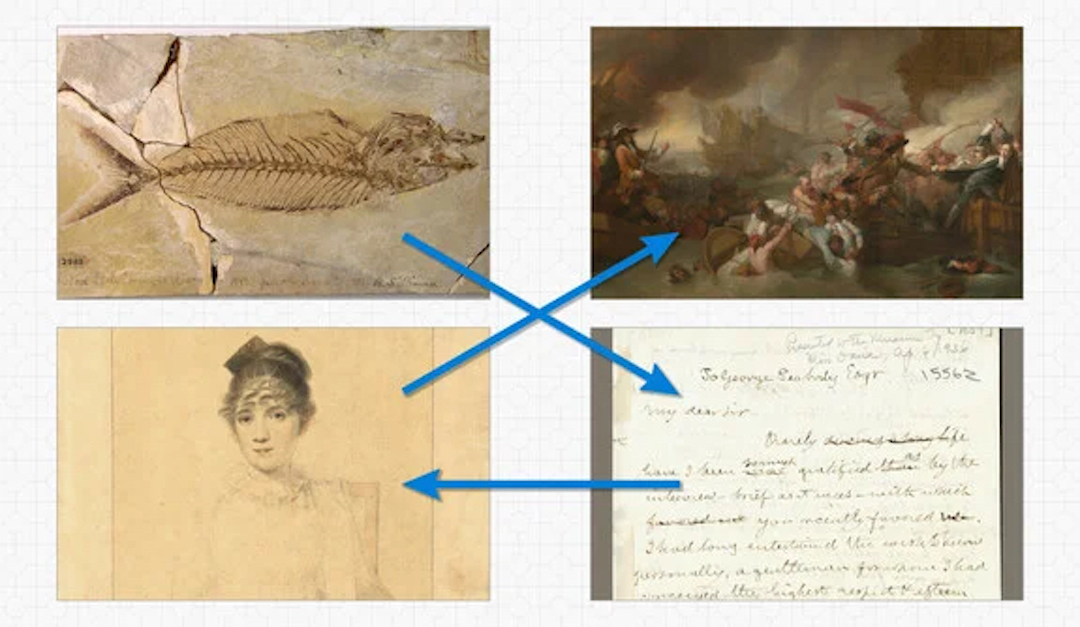
For example, when an individual searches “Benjamin Silliman” in the hub, the search engine first returns with a fossilized fish skeleton collected by Silliman housed in the Yale Peabody Museum.
It connects the artifact to an 1857 letter written to philanthropist George Peabody, who established the institution. The scientist’s wife, Harriet Trumbull, appears as the subject of a watercolor sketch now belonging to the Yale University Art Gallery.
This then links to her uncle John Trumbull, an artist mentored by Benjamin West that helped to complete the painting Battle of La Hogue, which resides in the Yale Center for British Art. All of this was uncovered just from a single search entry.
To put it simply, Lux helps researchers and curious minds use simple keywords or phrases to discover and sort through art, cultural, and scientific heritage objects and the interesting ties among them and people, places, and events.
“This groundbreaking tool brings together all the university’s collections through modern technology that will enrich discovery opportunities for users, making it easier for them to find what they’re looking for and explore new objects,” said Robert Sanderson, Yale’s Senior Director for Digital Cultural Heritage.
“We think Lux is game-changing for the cultural heritage domain. No other institution has a system with this level of capability,” he concluded.
[via Popular Science and Artnet News, images via various sources]


