
‘World’s Smallest’ Wine Glass Can’t Hold Much Drink, Only Possibilities
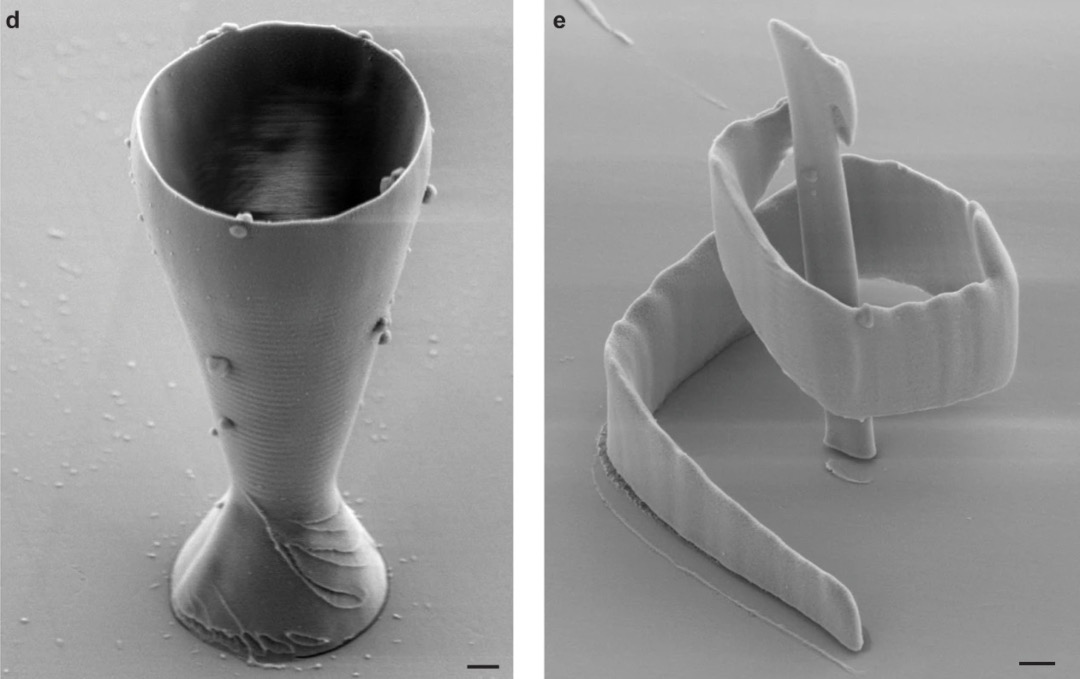
Image via Huang et al / Nature Communications (CC BY 4.0)
If you’ve had too many bottomless mimosas lately, consider taking this wine glass to your next brunch date to downsize your alcohol intake. That is, if you can even see the glass.
Researchers at the KTH Royal Institute of Technology in Stockholm believe they have have 3D-printed the world’s tiniest wine glass that’s made of actual glass. How small is it, you ask? Just know you won’t be drinking anything from it. The rim of the vessel is smaller than the width of a human hair, while the entire body is only a few dozen micrometers tall. You’ll need an electron microscope to look at it, let alone take a sip.
Rather than helping people cut back on booze, the cup serves as living proof that you can produce nanoscale silica glass structures using the simplified (or distilled) 3D-printing technique invented by the team, who has published their research in a paper on Nature Communications.
These materials would be handy as parts for applications ranging from telecommunications to robotics, explain the scientists.
The new method will significantly reduce the complexities and energy usually required to 3D-print silica glass, which often needs to be heated “several hundred degrees for hours,” explains Po-Han Huang, a doctoral student and the lead author of the study.
“The advantage of our method is there’s no need for thermal treatment and the glass can withstand extreme heat in applications,” Huang reiterates.
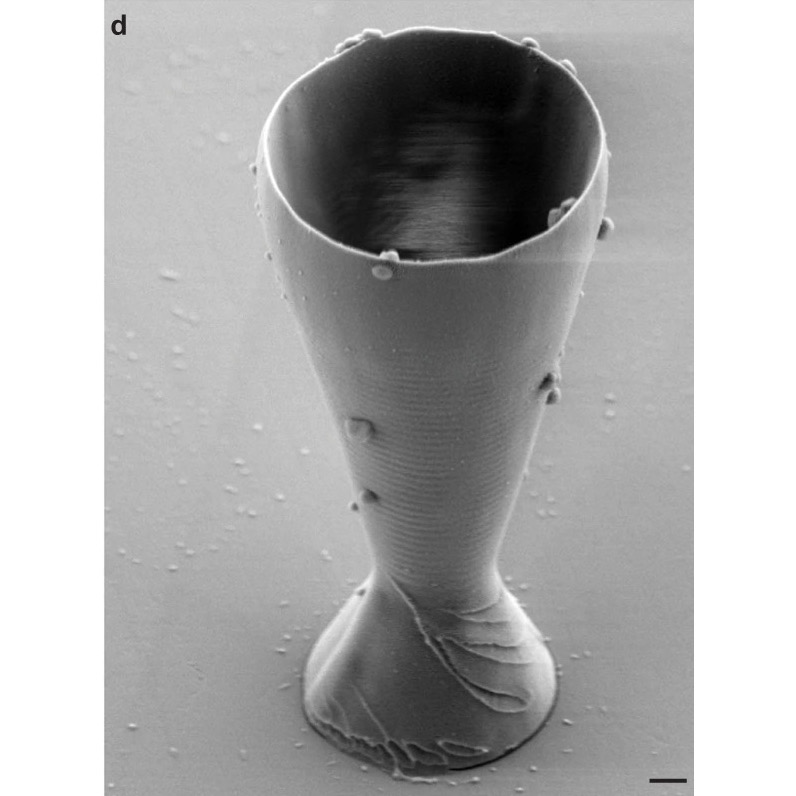
As a bonus, it also enables the making of silica glass using ready available materials, Huang adds.
Whether or not the wine glass is indeed the world’s smallest is debatable. The scientists say they can’t know for sure, because people are 3D-printing stuff for research purposes all the time. But, “definitely nobody has 3D-printed a wine glass that consists of glass as-printed,” notes KTH professor Frank Niklaus from the study.
All told, currently, the Guinness World Records recognizes another wine glass as the “world’s smallest.” That version, created in 2000, had a diameter of 2,750 nanometers.
Besides a nano wine glass, the team also 3D-printed imperceptible replicas of a spiral, a cantilever, a set of needles, an optical resonator, and the university’s logo.
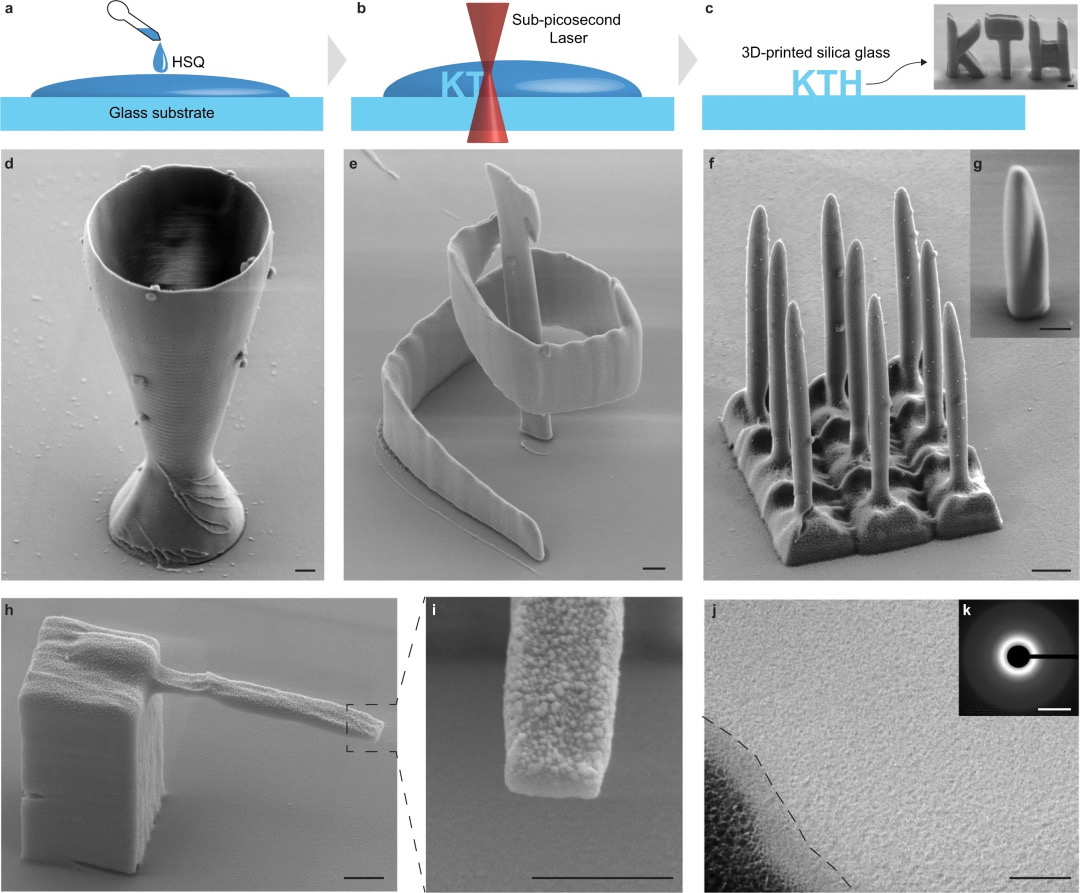
But those sculptures are just small, small fries, so to speak. The team anticipates its 3D-printing technique being used to produce even more ambitious objects, like custom lenses for medical machinery for minimally-invasive surgeries, micro-robots, filters and couplers for fiber optic networks, and much more.
Already, the members have 3D-printed a fiber optic filter “on the tip of an optical fiber as thin as a strand of a human hair,” reads the news release.
And why is that important? “The backbone of the internet is based on optical fibers made of glass. In those systems, all kinds of filters and couplers are needed that can now be 3D-printed by our technique,” outlines the paper’s co-author Kristinn Gylfason, an associate professor of Micro- and Nanosystems at KTH. “This opens many new possibilities.”
We’ll toast to that!
[via Phys.org and New Atlas, images via Huang et al / Nature Communications (CC BY 4.0)]


