
NASA Is Putting Up Four Volunteers At 3D-Printed ‘Mars Habitat’ For Over A Year
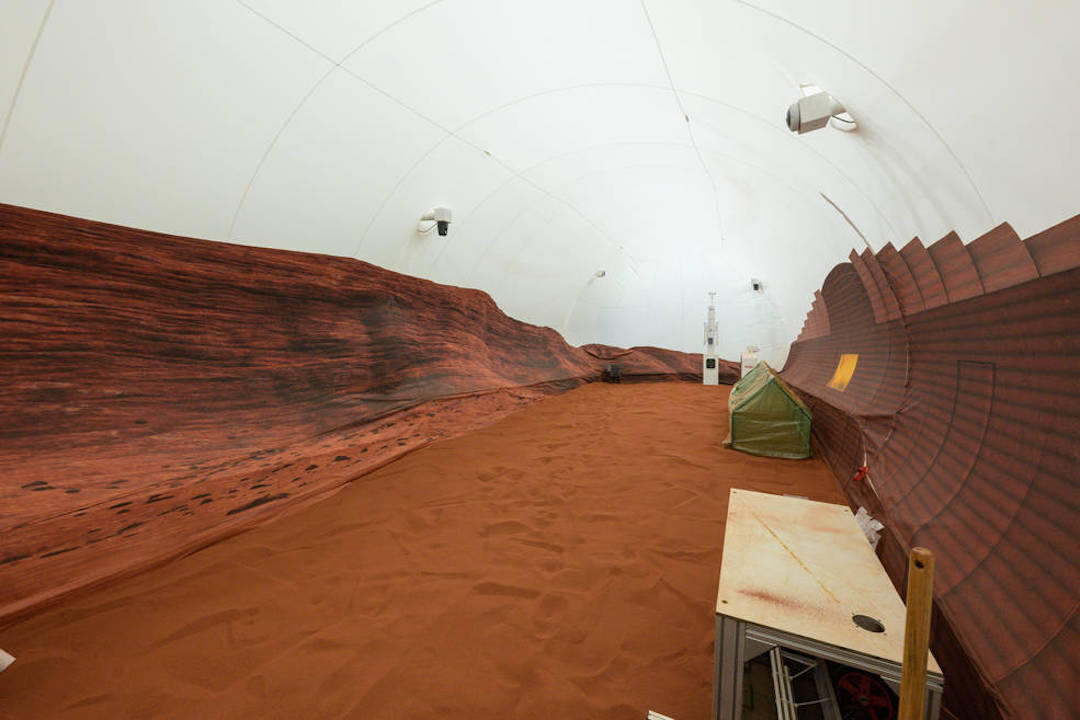
Fancy giving it a go living on Mars… but on Earth? Well, if that sounds confusing, it’s because NASA recently selected four volunteers who will live together in a simulated Mars habitat for 378 days—yes, over a year.
The 3D-printed enclave, which will remain on the ground, is situated at the Johnson Space Center in Houston, Texas. According to the agency, the main aim of the simulation is for researchers to better understand how humans could live on the Red Planet during extended missions.
This experiment will be the first of a series of year-long stays on the “Martian” surface. In reality, no one’s being blasted off into space, but volunteers will be cooped up in an isolated 1,700-square-foot habitat—dubbed the Mars Dune Alpha—for the entire duration.
Could you live here for one year? A crew of four volunteers will spend one-year living and working inside this 1,700 square foot habitat located @NASAJohnson as part of a simulated journey to Mars. Learn more about the mission: https://t.co/x5chK7DEcG pic.twitter.com/1Lx38Je6AF
— NASA's Johnson Space Center (@NASA_Johnson) February 16, 2023
During the year on “Mars,” the crew will be tasked with conducting simulated spacewalks and providing data on a variety of factors, including monitoring their physical health, behaviors, and performance.
While the habitat does have private quarters, a kitchen, areas for medical, recreation, fitness, and work areas, and two bathrooms, it probably won’t be similar to an extended vacation. The crew will be met with realistic environmental stressors to capture the most accurate data.
Four volunteers are about to embark on an out-of-this-world experience without leaving Earth!
— NASA's Johnson Space Center (@NASA_Johnson) June 20, 2023
Watch live on June 25 at 6:30 p.m. CDT as the very first CHAPEA crew enters our simulated Mars habitat to begin their yearlong journey to support human health and performance research.… pic.twitter.com/Ur2EvgRDsq
NASA revealed that these challenges include limited resources, isolation, equipment failure, and significant workloads. Apart from spacewalks, the crew will have to engage in virtual reality, grow crops, prepare meals, exercise, keep up with basic hygiene, and perform maintenance work.
The first year-long experiment will see research scientist Kelly Haston, structural engineer Ross Brockwell, emergency medicine physician Nathan Jones, and US Navy microbiologist Anca Selariu be confined together.
Haston, who is designated as the commander of the mission, said the challenge spotlights the “best qualities of humankind,” describing her fellow crew members as an “amazing group of dedicated individuals” who were passionate about space exploration and scientific research.
The first crew to live and work in a ground-based, simulated Mars habitat for a year are set to begin their journey this summer! During their mission, the crew will conduct simulated spacewalks or “Marswalks” – some using VR – and robotics operations. pic.twitter.com/3rqrG4Tc39
— NASA's Johnson Space Center (@NASA_Johnson) March 17, 2023
CHAPEA's 4 person crew just entered their home for the next year. They're simulating a Mars mission to help assess health and performance in relation to Mars resource limitations in isolation and confinement. The door is officially closed and the mission has begun. Go Crew 1! pic.twitter.com/KKWKQ1opwg
— NASA's Johnson Space Center (@NASA_Johnson) June 25, 2023


