
X (Twitter) Attempts To Woo Advertisers Back By Adding ‘Sensitivity Settings’
Ever since Elon Musk took over Twitter, he has been on a campaign to strip it of everything people once knew the platform for. In one of the most significant moves, he changed its name and identity and even kicked the blue bird out of its nest in favor of the new brand X.
Aside from completely overhauling one of the mainstay social media sites, the company has also reformed its APIs and, with that, has lost over 50% of its revenue after the departure of its big-name brands. Now, it’s trying to take measures to welcome these brands back by issuing a new system of advertising tiers.
After the acquisition, the platform has also seen a surge in offensive and discriminatory posts. Notably, the Center for Countering Digital Hate (CCDH) reported an influx of content involving racism and anti-Semitism from Twitter Blue accounts, which have overshadowed the platform’s positive aspects. Moreover, X has faced criticism for its seeming inability to effectively counteract harmful content propagation.
Notably, some prominent names, including Coca-Cola, Unilever, and Microsoft, have opted to halt their advertising expenditures on the platform.
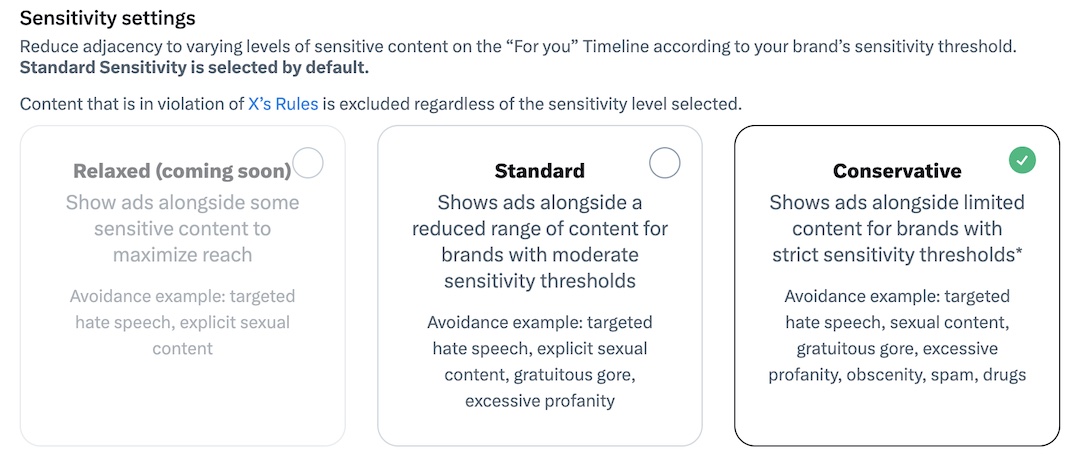
X has devised a new approach to address these concerns by rolling out a tailored set of ‘sensitivity settings’ for advertisers. These settings come in three levels named “conservative,” “standard,” and “relaxed,” each offering distinct levels of content filtration.
The “conservative” option adopts the most stringent measures, while “standard” balances content variety and preferences. Meanwhile, “relaxed” imposes the fewest limitations on the type of content ads could be placed alongside.
X’s initiative involves leveraging machine learning to curtail the likelihood of ads appearing adjacent to content that might conflict with an advertiser’s chosen sensitivity threshold.
An official date for a full rollout has not yet been announced, and only a trial for the feature is currently available.


