
3D-Printed Vegan Seafood Floats To Tackle Overfishing While Carping Health Gains
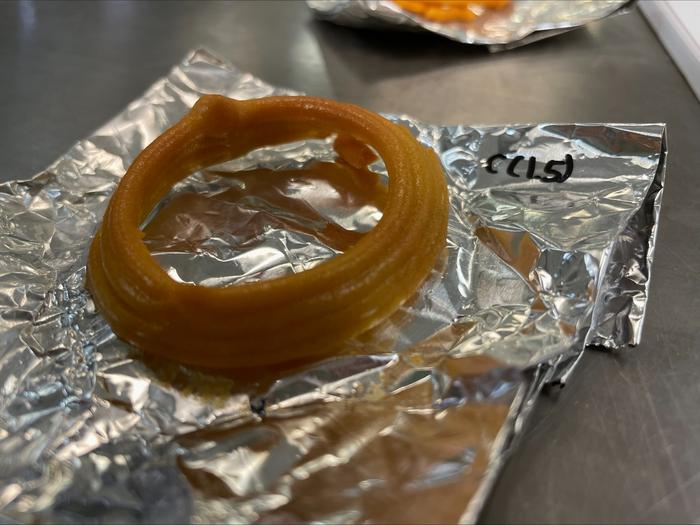
A piece of air-fried, 3D-printed plant-based calamari ring, which “resulted in a quick, tasty snack,” proclaim the researchers. Image by Poornima Vijayan / American Chemical Society via EurekAlert
For once, catfishing sounds like a good idea. Using a 3D printer and underused food byproducts, researchers have cooked up a novel method to create plant-based seafood that could appease both fish lovers and tree-huggers.
Amid concerns about overfishing and unsustainable practices in the seafood industry, this innovative approach offers a sustainable solution to satisfy seafood cravings without contributing to environmental harm. It also creates “desirable vegan seafood mimics that taste good, while maintaining the healthful profile of real fish,” per the team.
Set to outline their breakthrough at the American Chemical Society (ACS) fall meeting, the team’s sumptuous concept involves 3D-printing an ink formulated from microalgae protein and mung bean protein. This approach results in calamari rings that are not only visually convincing but can also be air-fried for a convenient, flavorful snack.
The urgency to explore such alternatives is driven by the vulnerability of global seafood supply due to overfishing and environmental factors. Poornima Vijayan, a graduate student involved in the research, highlights the importance of alternative protein sources—especially in regions like Singapore, where she is based, which heavily relies on imported fish.
Dejian Huang, PhD, the principal investigator of the research, emphasizes the motivation behind this endeavor: crafting protein-based products that closely match or surpass the nutritional profile of real seafood while addressing sustainability concerns. Their earlier work focused on legume protein for seafood mimicry, where through 3D printing, they succeeded in replicating the texture and flakiness of real fish—even giving it individual fatty, smooth, fibrous, and chewy layers.
The team explored microalgae and mung beans as plant-based protein sources for the vegan seafood mimic. Some microalgae already possess a hint of the ocean’s taste, making them a viable squid replacement. Mung bean protein, an underutilized byproduct from the making of starch noodles, showcased promise due to its high protein content.
The researchers combined microalgae and legume proteins with plant-based oils containing omega-3 fatty acids. The resulting high-protein paste closely matched the nutritional composition of squid-based calamari rings. Utilizing 3D-printing technology, they constructed the vegan calamari’s structure and texture in a layered fashion, creating rings reminiscent of the real thing.
Another win is that the plant-based alternative could be well-suited for those with allergies to shellfish. Those with sensitivities to microalgae and mung bean proteins, on the other hand, would have to sit out. With that said, the team isn’t aware about many cases of such allergies, “but we don’t know yet because it’s still a new combination,” Huang acknowledges.
The researchers were pleasantly surprised by the promising taste and texture properties of the 3D-printed rings when they air-fried them, adding that the product can also be baked, fried, sautéed and so on.
Still, eaters may sense something fishy with the current iteration. “The goal is to get the same texture and elastic properties as the calamari rings that are commercially available,” says Vijayan. “I’m still seeing how the composition impacts the product’s elasticity and the final sensory properties.”
Nevertheless, “I think people will like our plant-based mimic,” she elaborates. “From a novelty perspective, it has that seafood taste but comes from only sustainable plant-based sources.”
As they refine their approach, the team envisions creating numerous prototypes and assessing their viability for large-scale food production. In the coming years, these plant-based seafood alternatives could find their way into high-end restaurants or specialty stores.
[via Phys.org and ScienceDaily, cover image by Poornima Vijayan / American Chemical Society via EurekAlert]
This article was crafted with assistance from an AI engine, and has been manually reviewed & edited.


