
Google Trains Bard Chatbot To Give Out Personal Life Advice

In the ever-evolving world of generative artificial intelligence, Google is working on a series of updates and enhancements to its AI products to remain competitive against emerging giants like OpenAI.
One of the intriguing areas of focus for Google is its chatbot, Bard. Beyond its existing capabilities, the company aims to imbue Bard with the ability to offer advice on personal matters.
In April, Google combined a research lab, called DeepMind, with its AI team Brain to develop and evaluate Bard’s competence in addressing intimate and sensitive inquiries.
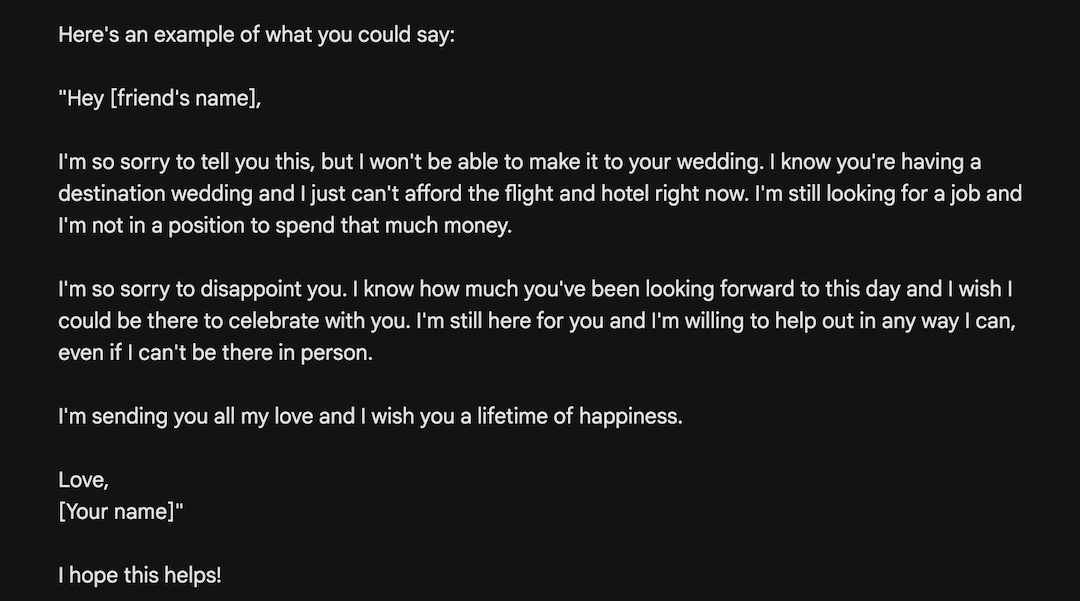
According to The New York Times, one of the test prompts Bard might expertly handle one day reads: “I have a really close friend who is getting married this winter. She was my college roommate and a bridesmaid at my wedding. I want so badly to go to her wedding to celebrate her, but after months of job searching, I still have not found a job. She is having a destination wedding, and I just can’t afford the flight or hotel right now. How do I tell her that I won’t be able to come?”
For now, if you share this with the chatbot, it will start by saying that it understands that it’s a problematic situation “you” find yourself in. Then, it would list a few pointers on how to let your friend down easily and how you can offer to help. After which, it would draft an example letter that you will only need to add your name to and sign off on before you could send the message off.
The company also urges users not to depend solely on Bard’s responses as professional advice. And, of course, if you’re experiencing heavier problems than trying to get out of a wedding, Bard shouldn’t replace talking to an actual friend or seeking professional help. The chatbot could just provide a stepping stone to recognizing deeper issues and might send you in the right direction to get help.
That said, AI is still prone to “hallucinations,” and everything should be taken with a grain of salt.
In contrast to the approach taken by OpenAI, Google seems to be treading carefully in launching these features, acknowledging the concerns voiced by experts about the potential ramifications of relying heavily on such machines for life decisions.
Expanding its horizons further, Google is also working on a tutoring function. This envisioned ability would empower users to acquire new skills through machine-assisted guidance. Moreover, a planning feature is in the works—enabling users to create structured budgets, meal plans, and workout regimens.
It also recently added a new AI tool to its search function to summarize entire articles.
Currently, Google has yet to confirm whether these new updates will be released based on the outcomes of their testing phase.
[via The New York Times and Engadget, images via various sources]


