
Pompeii Bedroom Excavation Reveals Uncomfortable Living Conditions Of Slaves
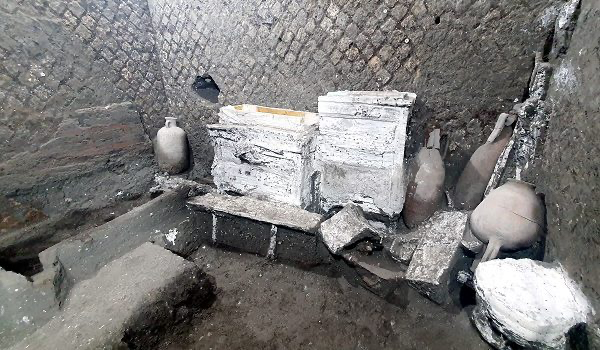
Image via Pompeii Sites
In ancient Rome, society’s lower classes rarely had their voices heard. Now, long-forgotten objects preserved by hardened ash shed a little light on their lives.
Archaeologists have uncovered what is most likely a bedroom for slaves in a villa about 600 meters (1,968 feet) north of the walls of Pompeii. The way it was arranged, along with its grungy conditions, paint a picture of servants’ way of life.
There are two beds in this small room, but only one of them has a mattress, indicative of a hierarchy even between slaves.
The quarters also contain two small cupboards and a handful of pots and ceramics, which retain the remains of two mice and a rat. One of the critters was hidden in a crate underneath the bed, frozen in a position that suggested it was trying to escape the tremors of Mount Vesuvius.
Per approfondire è possibile consultare l’E-Journal degli Scavi di Pompei al seguente link: https://t.co/Ix9TFXcuEm@GZuchtriegel
— Pompeii Sites (@pompeii_sites) August 20, 2023
“We know that the owners used various privileges, including the possibility of forming a family, albeit without any legal protection, to bind some slaves more closely to the villa,” shares Gabriel Zuchtriegel, the director of Pompeii Archaeological Park, in a press release entitled Of Mice and Men. “What emerges here is the social structure of servitude that was meant to prevent escapes and forms of resistance.”
Researchers, however, did not detect traces of window grilles, shacks, padlocks, and the ilk in the room. “It seems that control was mainly [enforced] through the internal organization of the servants, and not through physical barriers and constraints,” Zuchtriegel explains.
Archaeologists first explored the Civita Giuliana villa, where the quarters were discovered, between 1907 and 1908. In 2017, the site was searched again when law enforcers learned its relics had been dug up by robbers.
The room is still telling its tale almost 2,000 years after the deadly Pompeii eruption, as the thick ash from Mount Vesuvius has kept the original shapes and forms of an ill-fated civilization.
Researchers have been able to replicate these materials by filling the cavities of the ash with plaster.
[via DW and Reuters, images via Pompeii Sites]


