
Is This Hilma Af Klint Painting At Tate Modern Hung Upside Down?
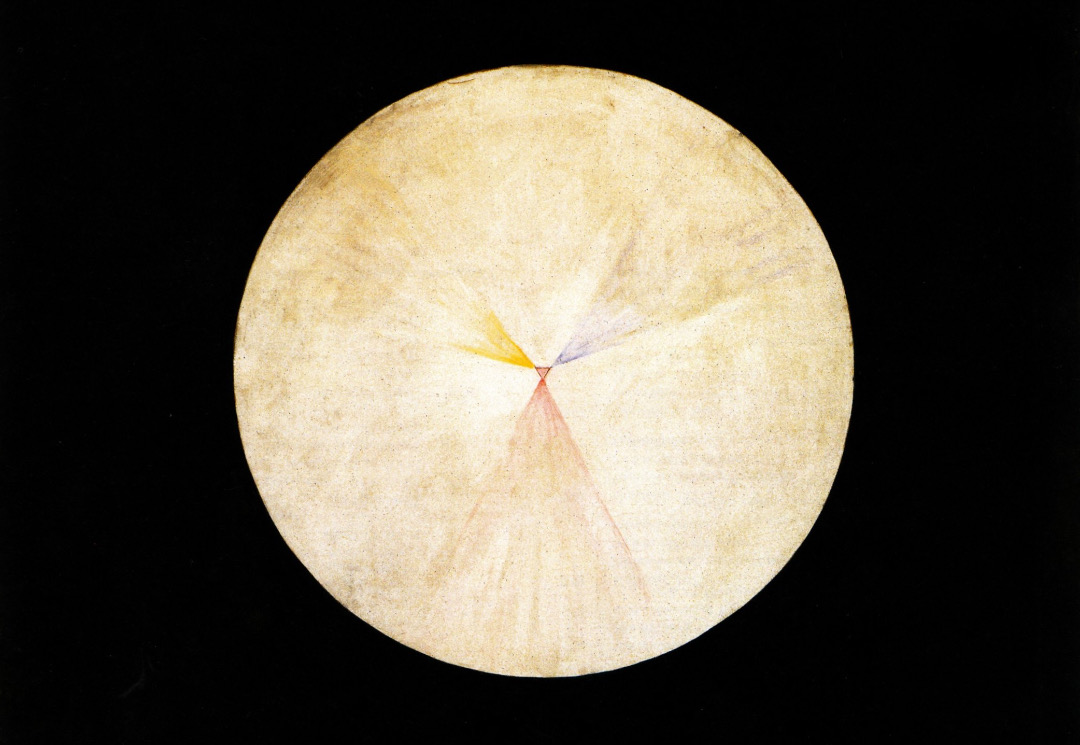
Image via Iliazd / Flickr / Wikimedia Commons (Public Domain Mark 1.0) {{PD-US-expired}}
Hilma af Klint was a visionary pioneer of abstract art well ahead of her time. Her works, often characterized by bold, geometric forms, vibrant colors, and intricate symbolism, transcend the confines of conventional art, inviting viewers to contemplate the intersection of the material and the spiritual.
Today, her canvas pieces continue to mystify, albeit in an unexpected way. The Swan no. 14, displayed from April until recently at Tate Modern in London as part of a double exhibition featuring Klint and Piet Mondrian works, has left art appreciators wondering if it was being shown in the way it was intended.
Katie Boyle, an American tourist, and her wife have posited that the painting—with yellow and blue rays at the top and pink at the bottom—was hung upside down.
Alarm bells first went off for the visitors when they noticed that the triangle in the middle of the piece was inverted, which was inconsistent with the other paintings in Klint’s Black Swan series.
An eagle-eyed Hilma af Klint fan claims that Tate hung a painting upside down. The artist’s Foundation has vowed to investigate: https://t.co/6E8214ygGs pic.twitter.com/NqoLpZyVXs
— Artnet (@artnet) September 13, 2023
It gets even more suspicious when you consider Klint’s metaphysical influences. As reflected in the accompanying works, yellow, the artist’s way of depicting masculine energy, and blue, representing feminine energy, are often assigned at the lower portion. Pink, the artist’s symbol for spiritual love, typically radiates upward.
It would be uncharacteristic of Klint to position “banal” elements above the spiritual, the couple pointed out in a letter to Tate Modern and the Hilma af Klint Foundation, as cited by Artnet News. They further reiterated how the composition in The Swan no. 14 was at odds with Klint’s other pieces.
The debate is reminiscent of a revelation involving a masterpiece by Mondrian, who, interestingly enough, was the other artist celebrated in the dual retrospective. Last year, it was discovered that modern artist’s 1941 New York City 1 had been portrayed upside down for 75 years.
The visitors drove their theory home by pointing out that, in Klint’s Blue Books, sold at the museum’s gift shop, the artwork in question is presented inverted to its orientation at the exhibition.
Validating these arguments, the Hilma af Klint Foundation says it will investigate the piece’s frame for marks suggesting how it used to be hung.
The foundation’s CEO, Jessica Höglund, also notes that the organization personally relies on Klint’s Blue Books, a selection of 10 sketchbooks, to interpret her works.
The exhibition ended its run at Tate Modern last week, and is poised to head to the Kunstmuseum Den Haag in the Netherlands in October. This means the foundation can only study the piece after February 25, when the show is scheduled to conclude.
[via Artnet News, images via various sources]
This article was crafted with assistance from an AI engine, and has been manually reviewed & edited.


