
Scandalous Victorian Painting Of A Murderess Who Killed With Potions
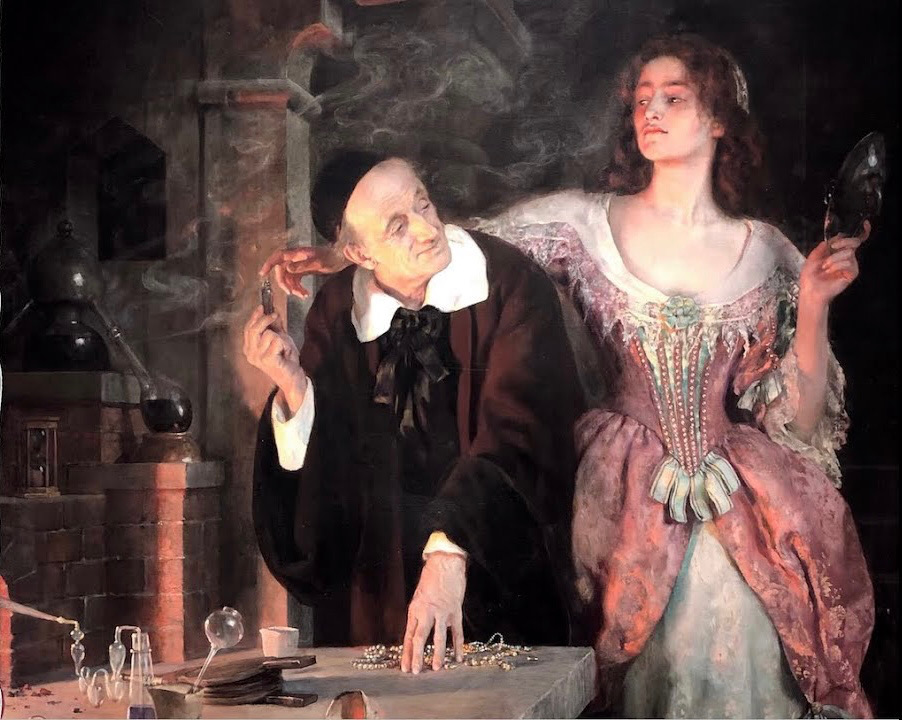
Video screenshot via Arts of Imagination Foundation / PR Newswire
Some pictures paint more than a thousand words. In the 19th and 20th centuries, British painter John Collier subverted expectations of scenes depicting women of virtue and big, healthy families with narratives that confronted Victorian societal standards. Dubbed “problem pictures,” his artworks and their mysterious subjects invited the public to form their own controversial speculations.
One of these notable paintings, The Laboratory (1895), was recently acquired by the Los Angeles-based Arts of Imagination Foundation for an unspecified amount following a private sale at Christie’s Auction House in New York. It portrays a murderess hatching a sinister plot to eliminate her husband’s lover, employing the arcane skills of an alchemist to brew a lethal potion.
Like many of your favorite crime series today, this is based on a true story. Drawing inspiration from Robert Browning’s salacious 1844 poem of the same name, it recalls the dark and chilling account of the Marquise de Brinvilliers, one of the earliest recorded female serial killers in the world. Her shocking crimes rocked Paris in 1676, culminating in her beheading after being found guilty of poisoning her father and two brothers to accelerate her succession of the family inheritance, as well as attempting to murder her estranged husband.
Collier, renowned for his Pre-Raphaelite art style, often delved into mythic and literary themes, challenging conventional Victorian ideals of womanhood. The Laboratory stands as a pinnacle of his career, providing a window into the more enigmatic and seductive aspects of femininity than the prevailing ideals of the time.
The Laboratory (1895) by John Collier (English artist and writer, lived 1850–1934). An old alchemist and a young woman. But what is she trying to take from his hands - and why?🤔#PreRaphaelite style. pic.twitter.com/BU1KEmHtsq
— The Long Victorian (@longvictorian2) May 9, 2023
The painter frequently applied lighting techniques to his work to create suspense and ultimately drive gossip. This mastery is especially evident in this scene.
The Laboratory, 1895, by John Collier pic.twitter.com/XlZ8CTcaiy
— soli (@solisolsoli) March 17, 2021
“The flames cast an eerie glow on the two subjects’ features, illuminating the alchemist’s sardonic smile and his customer’s beautiful yet resolute features,” notes the nonprofit. “While Collier has chosen to render a scene where little physical drama occurs, it is still expertly laced with tension and melodrama.”
Its emotive storytelling compelled the Arts of Imagination Foundation to secure the piece and add The Laboratory to its permanent collection. The artwork will be publicly available, aligning with the organization’s mission to explore how stories and art influence culture and inspire personal discovery.
More than a static piece of art, the painting caused a sensation in London’s New Gallery in the spring of 1895 when it was displayed for the first time.
“The Laboratory was an immediate succès de scandale when it was first displayed at London’s New Gallery in the spring of 1895,” says Arts of Imagination. “Collier’s masterful use of light, in particular, [was] being deemed ‘remarkable.’”
And now, it takes center stage once again, inviting modern audiences to delve into its timeless allure.
“What I think is so special about this painting is that it’s a fixed object. It hasn’t changed since it was painted in 1895,” describes Laura Mathis, associate vice president, specialist, and Head of Sale for 19th-Century European Art at Christie’s.
“And yet it’s relevant to the story from the 17th century, it’s relevant to Browning’s poem, which was 50 years earlier than this, and it’s relevant to us today. We still are fascinated by this story.”
[via Hyperallergic and PR Newswire, images via various sources]
This article was crafted with assistance from an AI engine, and has been manually reviewed & edited.


