
Hybrid Monkey With Glowing Green Features Is Born In A World-First Live Birth
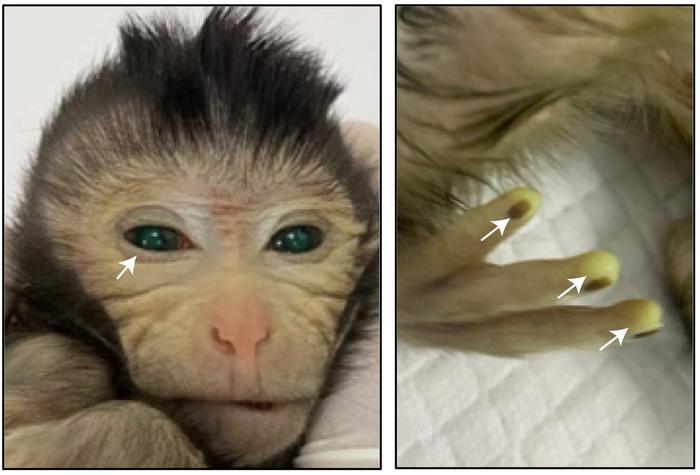
Image by Cell/Cao et al. via EurekAlert (CC BY-SA)
A group of Chinese scientists has made a notable advancement in the realm of genetics by delivering a live “chimeric” monkey from the stem cells of two distinct individuals of the same species. Seemingly validating this accomplishment was a green fluorescence that was incoporated into the animal’s DNA, indicating the presence of the foreign stem cells.
In a study published in the journal Cell on November 9, researchers detailed their method of integrating stem cells from one cynomolgus monkey, also known as a crab-eating or long-tailed macaque, into the embryo of a genetically distinct primate of the same species.
To do this, they first reverted cells from seven-day-old embryos to a pluripotent state—akin to a biological blank slate, thereby making them capable of developing into any cell type. These cells were then introduced into other embryos four to five days old.
After implanting these embryos into surrogate mothers, the team observed 12 pregnancies and six births, with at least one monkey showcasing a high degree of cell mixture, even within its brain.
The live-born hybrid monkey, alongside one miscarried fetus, exhibited a vast array of cell types from the stem cells, with the living monkey showing a chimera rate between 21% to 92% in various tissues. The researchers used the green fluorescent protein as a marker to trace the stem-cell-derived tissues, revealing their presence in essential organs like the brain and heart.
The stakes are high for this research, with potential ripple effects across medical science and conservation efforts. The infant not only offers a closer biological match to humans than rodent models, potentially elevating the study of neurological diseases and other medical inquiries but also suggests a novel approach to endangered species conservation.
Senior author Zhen Liu from the Chinese Academy of Sciences highlights the dual significance of their work, both in understanding pluripotency among primates and in applying this knowledge to practical fields like genetic engineering and conservation.
“This is a long-sought goal in the field,” notes Liu. “This research not only has implications for understanding naive pluripotency in other primates, including humans, but it also has relevant practical implications for genetic engineering and species conservation. Specifically, this work could help us to generate more precise monkey models for studying neurological diseases as well as for other biomedicine studies.”
However, within this scientific triumph lies a tangle of ethical questions. The chimeric monkey was put down at 10 days old due to health complications, a sobering reminder of the delicate balance between scientific discovery and the welfare of sentient beings.
Furthermore, the researchers themselves acknowledge the need to fine-tune this process, as the low survival rate of these chimeric creations calls for a reassessment of the methods employed.
While the study marks a pioneering moment in genetics, promising advancements in medical research and conservation, it also underscores the critical importance of ethical deliberation in the wake of such scientific breakthroughs. It’s a narrative that's as much about where we are heading in our scientific endeavors as it is about the responsibility that comes with venturing into the unknown.
[via Nature, CNN, Cell Press / EurekAlert, cover image by Cell/Cao et al. via EurekAlert (CC BY-SA)]
This article was crafted with assistance from an AI engine, and has been manually reviewed & edited.


