
1600s Portrait Has ‘Kylie Jenner Treatment’ Undone To Regain Natural Beauty
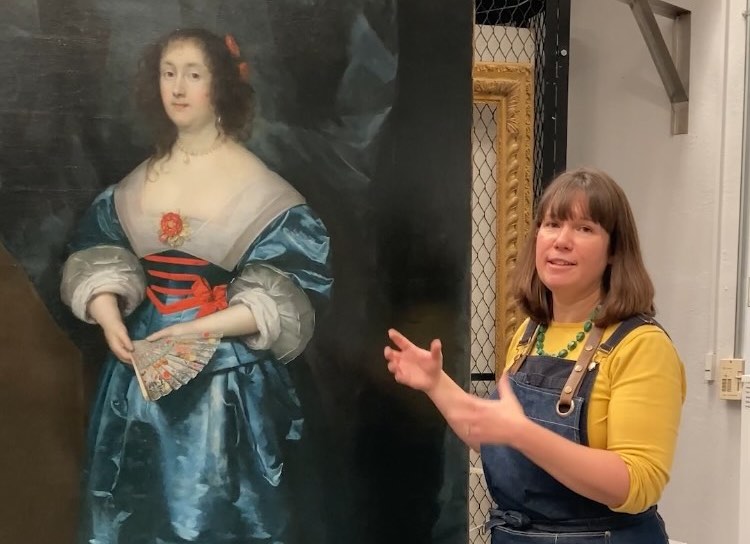
Video screenshot via English Heritage
Reading between the lines and a subject’s lips, English Heritage has made a fascinating discovery in its art collection: a 17th-century portrait of Diana Cecil, a prominent Jacobean noblewoman, had been modified long after its original creation to match evolving beauty standards.
The painting, done by Cornelius Johnson in 1634, was found to have undergone alterations in the 19th or 20th century.
Cecil’s lips, it turns out, had been plumped up through overpainting, giving her a fuller pout—resulting in what has been coined today as the “Kylie Jenner treatment.”
Additionally, her hair had been reworked by a Victorian restorer to create the illusion of a smaller forehead.
Think Kylie Jenner’s penchant for fuller lips reflects a very modern beauty phenomenon? Think again! 💄
— English Heritage (@EnglishHeritage) November 24, 2023
After careful conservation, our experts discovered that a 19th-century restorer had given Diana Cecil the Hollywood treatment, including plumper lips and a lower hairline. 🎨 pic.twitter.com/DT5i2NskyZ
In recent efforts to revive the work, conservators undid the fillers, allowing Cecil’s natural visage to shine through once again. Alongside this, the portrait underwent a thorough cleaning to remove layers of yellow and aging varnish, regaining the original colors.
View this post on Instagram
This effort not only showcased Cecil’s unaltered appearance but also brought to light the portrait’s true date (1634) and the original artist’s signature.
Diana Cecil, born in 1596, was a notable figure of her era. She hailed from a powerful noble family at the Jacobean court and was renowned as a great beauty during her time. Notably, she was the great-granddaughter of William Cecil, one of Queen Elizabeth I’s closest confidants and advisors.
The restored portrait, now believed to be a true reflection of Cecil’s untouched beauty, will be showcased at Kenwood House in North London on November 30. It will be displayed alongside another portrait of her in her youth and one of her husband, Thomas Bruce, the 1st Earl of Elgin, as part of the Suffolk Collection. This display offers a rare glimpse into the aesthetics and life of 17th-century nobility, while inadvertently highlighting the fluidity of cosmetic trends through time.
After hours of painstaking conservation work, we have now revealed Diana Cecil's original beauty. ✨ 🎨
— English Heritage (@EnglishHeritage) November 24, 2023
Take a look at the restoration process as her true face is revealed ⬇ï¸
📠The painting will be on display at Kenwood from 30 Nov pic.twitter.com/Z9a021tLUX
In another instance of old meets new values in art this week, a UK museum has reclassified a Roman emperor as a trans woman.
[via The Guardian and The Telegraph, video and images via English Heritage]
This article was crafted with assistance from an AI engine, and has been manually reviewed & edited.


