
Charred Vesuvius Scroll Partially Deciphered, Winning Students $700K
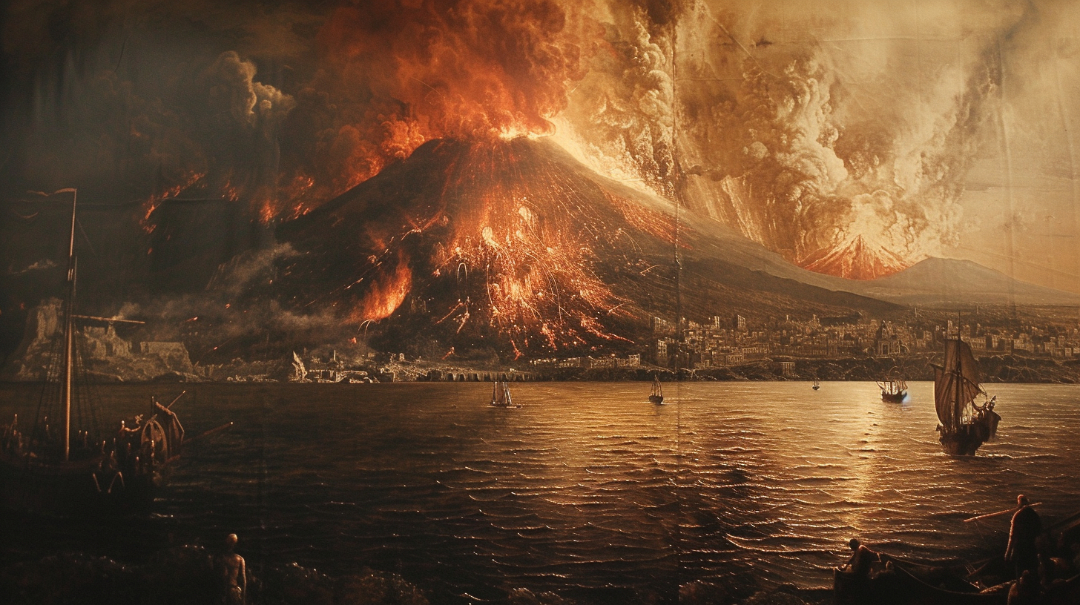
Image generated on AI
A trio of young researchers has cracked open the past, reading rolled-up texts from ancient Roman scrolls that were turned to charcoal by the catastrophic eruption of Mount Vesuvius in 79 CE. This accomplishment was pulled off through the Vesuvius Challenge, an international competition where participants leveraged machine learning and computer vision to peer into the carbonized layers of history. The team has won a whopping US$700,000 for the seemingly impossible feat.
The scrolls, unearthed from the ruins of Herculaneum, a town that—like Pompeii, fell victim to Vesuvius’s fury—have long tantalized historians. Stored in what is believed to have been the villa of Julius Caesar’s father-in-law, these papers represent one of the few surviving libraries from antiquity, rescued yet shrouded by volcanic ash.
Part of a collection discovered in the 18th century and now housed in Naples, the scrolls have resisted traditional attempts at reading due to the risk of physical damage. The Vesuvius Challenge, initiated by visionaries like Brent Seales, a computer science professor at the University of Kentucky, and former GitHub CEO Nat Friedman, in March 2023, sought to unlock these secrets without physically unrolling them and damaging the delicate relics.
Ten months ago, we launched the Vesuvius Challenge to solve the ancient problem of the Herculaneum Papyri, a library of scrolls that were flash-fried by the eruption of Mount Vesuvius in 79 AD.
— Nat Friedman (@natfriedman) February 5, 2024
Today we are overjoyed to announce that our crazy project has succeeded. After 2000… pic.twitter.com/fihs9ADb48
The competition attracted participants who applied advanced imaging techniques, such as high-resolution computed tomography (CT) scans, to virtually unroll the writings. The winning team, comprising Youssef Nader, a biorobotics PhD student from Egypt; Luke Farritor, a 21-year-old SpaceX intern; and Julian Schilliger, a Swiss robotics student, distinguished the ink from the papyrus using machine learning. They revealed 15 partial columns of ancient Greek text, offering a glimpse into a world 2,000 years removed from our own.
Among the texts brought to light, the Greek characters for “purple dye” or “cloths of purple,” stand out, offering a vivid glimpse into the luxurious aspects of ancient Roman life.
“Purple dye was highly sought-after in ancient Rome and was made from the glands of sea snails, so the term could refer to purple color, robes, the rank of people who could afford the dye or even the mollusks,” says Federica Nicolardi, assistant professor in papyrology at the Università degli Studi di Napoli Federico II. “But more important than the individual word is reading anything at all. The advance gives us the possibility to recover the text of the entire scroll.”
Today we are announcing a major breakthrough in the Vesuvius Challenge: we have read the first word from an unopened Herculaneum scroll.
— Nat Friedman (@natfriedman) October 12, 2023
The word is "πορφυρας" which means "purple dye" or "cloths of purple."https://t.co/0EDGBX4t4h
Congratulations to 21yo computer science… pic.twitter.com/VLwtU9I8xl
Believed to be the work of the Epicurean philosopher Philodemus, the script delves into discussions of pleasure and pain, abundance and scarcity, echoing debates that are still relevant today.
The author pondered on whether things offered in smaller amounts yielded more pleasure than those in abundance.
“As too in the case of food, we do not right away believe things that are scarce to be absolutely more pleasant than those which are abundant,” he is believed to have written. This argument is part of a broader philosophical debate, with the author critiquing those who fail to define pleasure adequately.
This passage was found near the bottom of the scroll, where philosophers would summarize their sharings or entice their reader by introducing topics they’d discuss later.
“In the closing section, he throws shade at unnamed ideological adversaries—perhaps the stoics?— who ‘have nothing to say about pleasure, either in general or in particular,’” Friedman comments.
The implications of this discovery are vast, opening up new avenues for understanding ancient philosophies, cultures, and daily life.
“Is the author Epicurus’ follower, the philosopher and poet Philodemus, the teacher of Vergil? It seems very likely,” quips Richard Janko, professor of classical studies at the University of Michigan. “Is he writing about the effect of music on the hearer, and comparing it to other pleasures like those of food and drink? Quite probably… So many questions! But improvements to the identification of the ink, which can be expected, will soon answer most of them. I can hardly wait.”
“Like other Epicureans, he valued pleasure above all—but pleasure rightly understood, not mere indulgence,” Professor Robert Fowler FBA, Henry Overton Wills Emeritus Professor of Greek at the University of Bristol, chimes in. “Living in ancient Rome—a society not known for abstinence—Philodemus could expect to meet with scepticism from his readers.”
Out $700,000, Friedman says the competition is “now poor” and is looking for more backers. Accordingly, SpaceX and Tesla CEO Elon Musk has stepped up to the challenge.
[via Ars Technica and Forbes, images via various sources]


