
NASA Rolls Out Alien World Catalog That Suggests We Are Not Alone
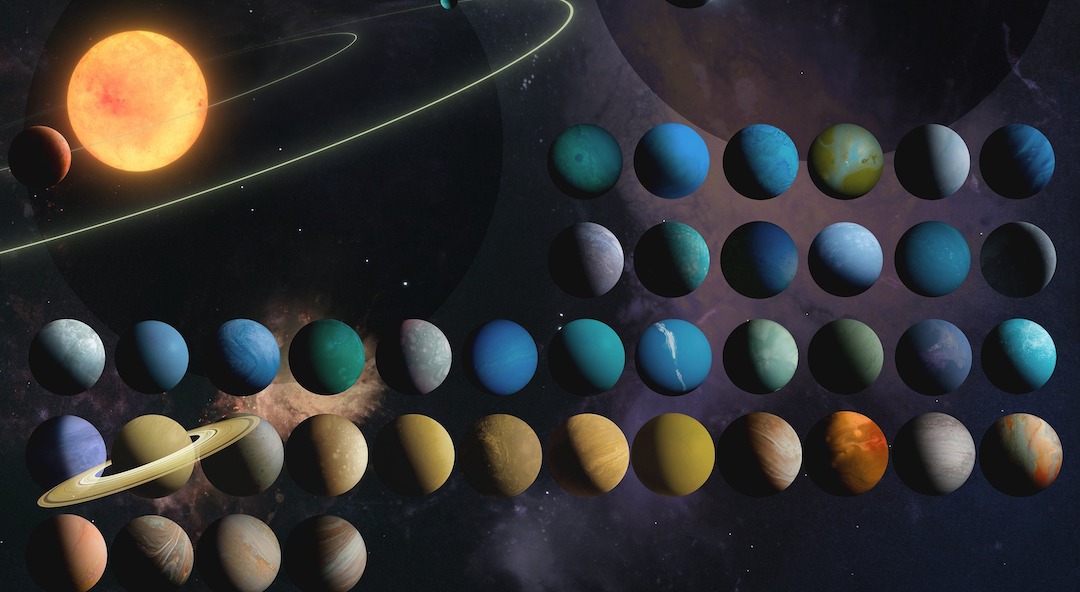
Image via W. M. Keck Observatory/Adam Makarenko / University of California, Riverside News
Science fiction has captured our imaginations with tales of distant worlds teeming with life. But the realm of exoplanets, planets orbiting stars other than our sun, is no longer the sole domain of fantasy. NASA validates this with the release of the new Exoplanet Catalog by its Transiting Exoplanet Survey Satellite (TESS) wing, in collaboration with the WM Keck Observatory in Hawaii.
Behold, a treasure trove of 126 exoplanets—worlds beyond our solar system—that challenge our understanding of planetary diversity. This comprehensive resource, available online, is a dynamic platform, continuously updated as new stellar discoveries are confirmed.
Each entry plunges deep into a specific exoplanet. Besides sharing a celestial body’s size, mass, and orbital period, the catalog also explores the characteristics of the host star, providing a holistic view of the planetary system. This information is crucial in the ongoing quest to identify potentially habitable worlds.
Mentions of certain alien worlds bring humankind back to Earth. You’ll peer into their peculiarities—some abnormal and exotic to us. A handful contain conditions conducive to life.
Through an interactive visualization feature, users can examine 3D models of these unusual worlds, witnessing the vastness of our neighborhood, from scorching gas giants to rocky worlds nestled within habitable zones.
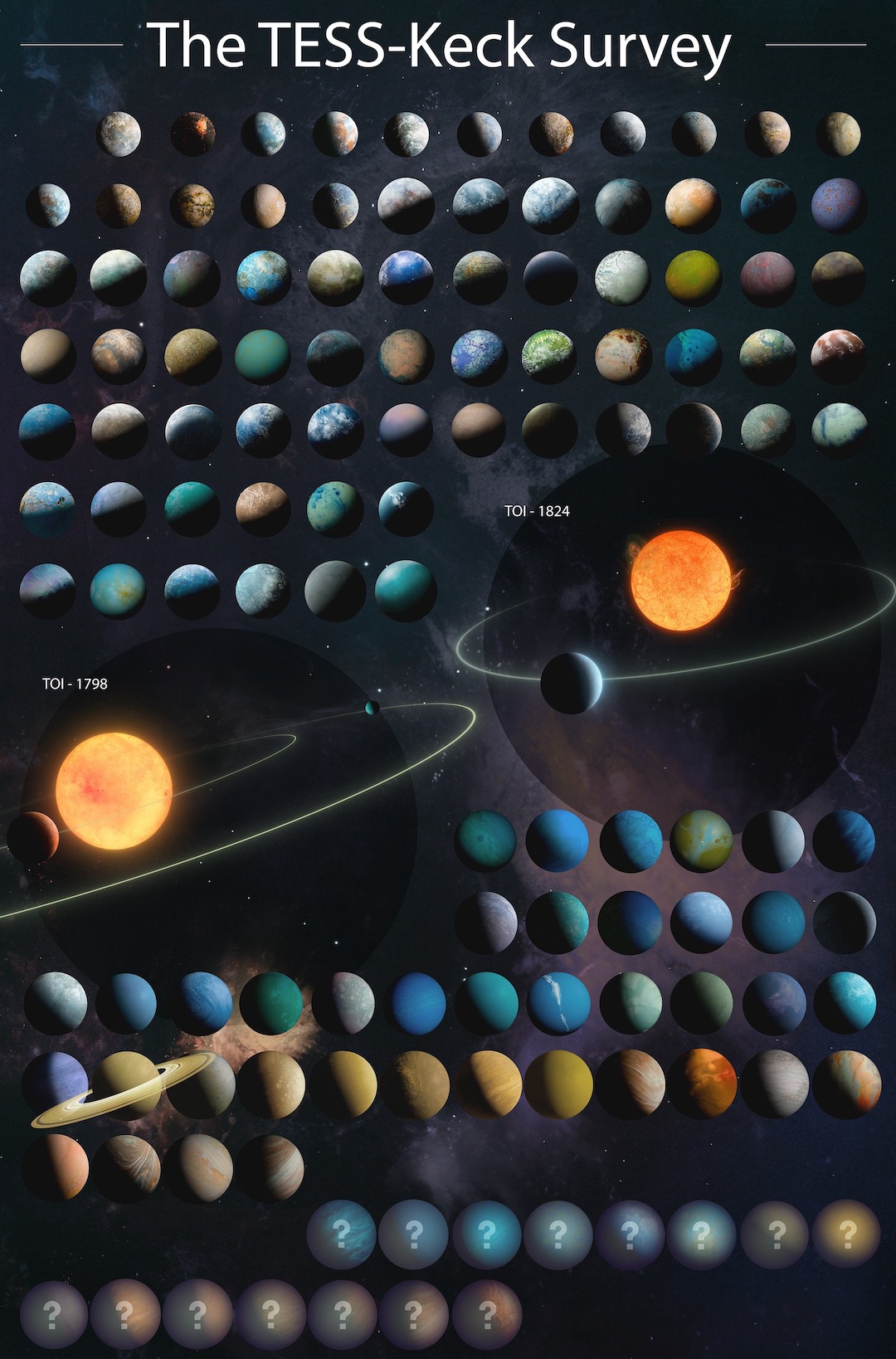
Image via W. M. Keck Observatory/Adam Makarenko / University of California, Riverside News
“With this information, we can begin to answer questions about where our solar system fits into the grand tapestry of other planetary systems,” expresses Dr Stephen Kane, the TESS-Keck Survey Principal Investigator and an astrophysicist at the University of California.
The comprehensive repository has been three years in the making, entailing approximately 13,000 measurements of tiny gravitational “wobbles” caused by exoplanets as they orbit their host stars. These subtle tugs cause stars to move slightly away from and then toward Earth. As stars shift away, their emitted light wavelengths stretch toward the “red end” of the electromagnetic spectrum, a phenomenon known as the Doppler effect. By measuring these minuscule shifts, astronomers can estimate the mass of the exoplanet causing the wobble.
As we explore these distant worlds, we gain insights into our own place and relative insignificance in the cosmic order.
[via Gizmodo Australia and Space.com, images via W. M. Keck Observatory/Adam Makarenko / University of California, Riverside News]


