
Eerie Robot Face Made Out Of Living Human Skin Cells Springs To Life—And Smiles
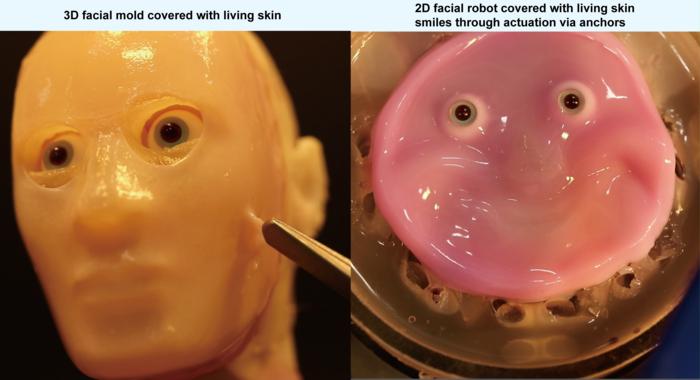
Image ©2024 Takeuchi et al / EurekAlert (CC BY-ND)
Robots are getting a facelift—literally. A scientific team at the University of Tokyo has developed a technique to cover robotic faces with lab-grown human skin cells, edging us closer to more lifelike human-robot interactions.
The Tokyo research team, alongside Michio Kawai at Harvard University, grew a mix of human skin cells on a collagen base, before placing it on a 3D-printed mold. This skin boasts tiny built-in anchors, inspired by human ligaments, that keep it flexible and prevent tearing as the robot moves. The innovative approach has been detailed in the Cell Reports Physical Science journal.
Image via University of Tokyo
Professor Shoji Takeuchi of the University of Tokyo acknowledges the team has only scratched the surface, no pun intended. While they’ve captured the basic look of human skin, there’s more work to be done. Future iterations might include wrinkles, a thicker layer of skin, and even sweat glands and nerves. Robots would probably not only learn to frown, but they might also feel the sun on their (artificial) faces! The scientists are also working on sophisticated “muscles” for the robots, allowing for more lifelike expressions.
“We believe that creating a thicker and more realistic skin can be achieved by incorporating sweat glands, sebaceous glands, pores, blood vessels, fat, and nerves,” shares Takeuchi. “Of course, movement is also a crucial factor, not just the material, so another important challenge is creating humanlike expressions by integrating sophisticated actuators, or muscles, inside the robot.”
The researcher adds: “Creating robots that can heal themselves, sense their environment more accurately and perform tasks with humanlike dexterity is incredibly motivating.”
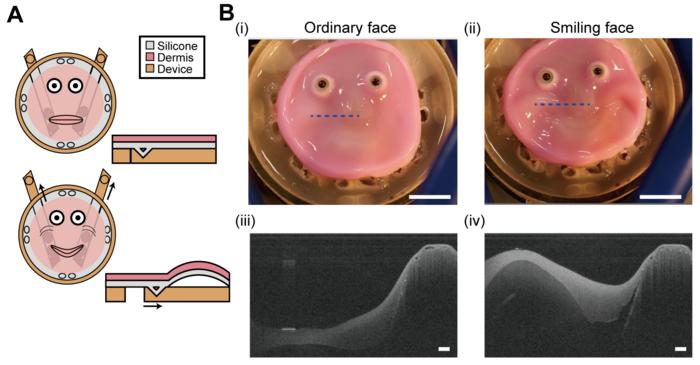
Image ©2024 Takeuchi et al / EurekAlert (CC BY-ND)
The implications of this research stretch beyond robotics. The cosmetics industry, for instance, could greatly benefit. During a month-long experiment, the robot face developed expression wrinkles, mimicking real skin’s aging process. This ability could be used to test new cosmetics and skincare products aimed at preventing or reducing wrinkle formation. However, the artificial skin currently lacks sensory functions and blood vessels, which limits its durability in open air. Researchers are now focusing on integrating neural mechanisms and perfusion channels into the skin tissue to address these challenges.
[via New Scientist, TechCrunch, Axios, images via various sources]


