
OpenAI Debuts AI Model With ‘Reasoning’ Skills On Par With PhD-Taking Humans
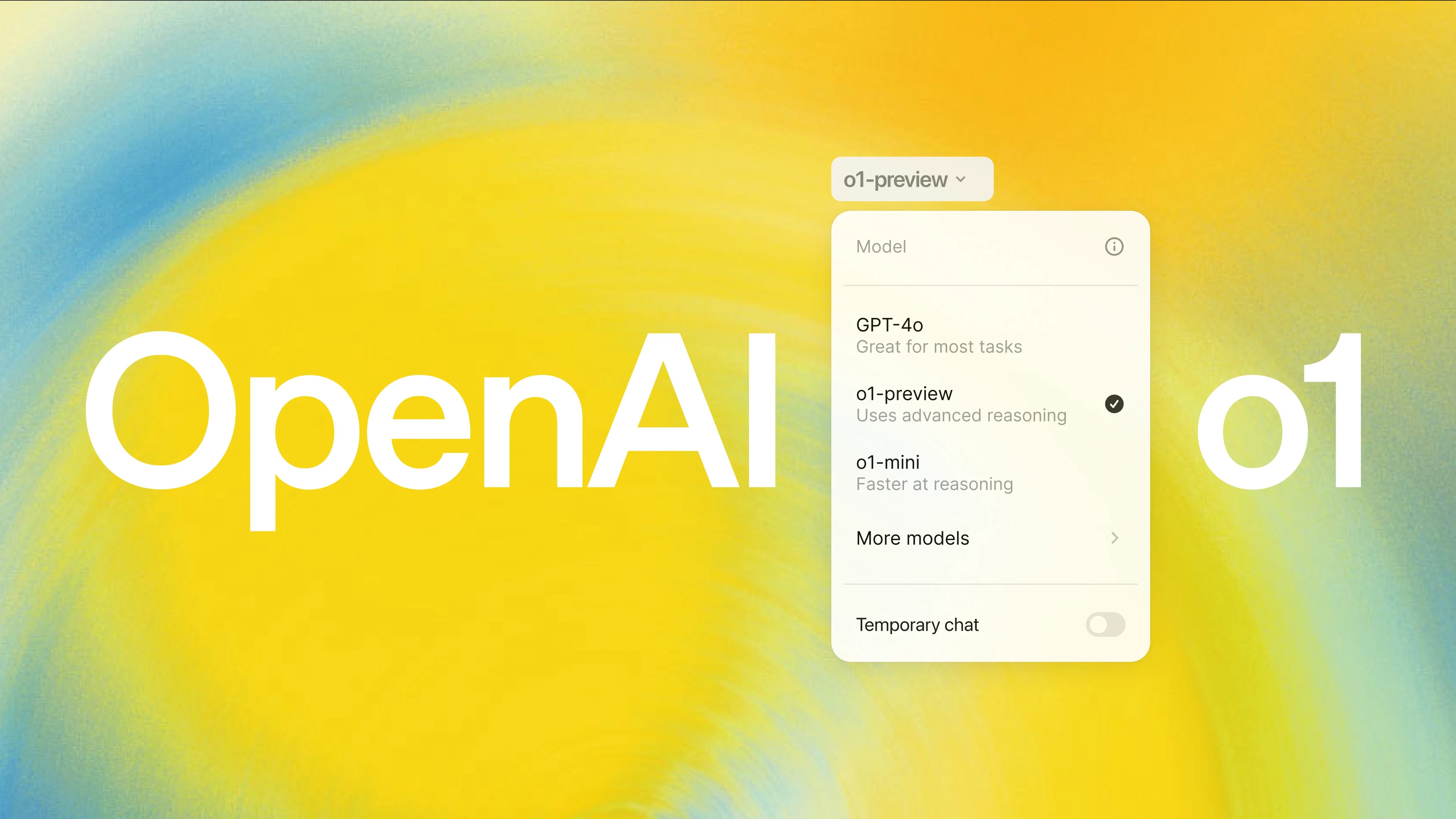
Image via OpenAI
OpenAI’s latest brainchild—for the lack of a better word—is created to excel in reasoning and problem-solving. The OpenAI o1 model series, comprising o1-preview and o1-mini, takes a more thoughtful approach to tackling complex tasks, spending additional time “thinking” before offering a response. This method mirrors human-like reasoning, positioning the artificial intelligence tool to thrive in areas such as science, mathematics, and coding.
Internally, the project was nicknamed ‘Strawberry’, but it officially debuted as o1 on Thursday, now available in ChatGPT and via its API. According to the company, it achieved a remarkable 83% on a qualifying exam for the International Mathematics Olympiad (IMO), a massive leap from its predecessor GPT-4o, which only scored 13%.
OpenAI o1 solves a complex logic puzzle. pic.twitter.com/rpJbh8FkAg
— OpenAI (@OpenAI) September 12, 2024
Additionally, the o1-preview model ranked in the 89th percentile in competitive coding contests, further proving its capabilities in handling complex tasks.
Today we rolled out OpenAI o1-preview and o1-mini to all ChatGPT Plus/Team users & Tier 5 developers in the API.
— Mira Murati (@miramurati) September 13, 2024
o1 marks the start of a new era in AI, where models are trained to "think" before answering through a private chain of thought. The more time they take to think, the…
“In our tests, the next model update performs similarly to PhD students on challenging benchmark tasks in physics, chemistry, and biology. We also found that it excels in math and coding,” notes OpenAI.
The o1 model stands out for its ability to refine its thinking through an iterative process. By testing different strategies and recognizing mistakes, the model can enhance its responses over time, offering more reliable solutions to tough problems.
However, these advanced features come with a trade-off. Users have reported that the model takes longer to respond due to the additional processing steps involved. Despite this, OpenAI remains optimistic about the o1 model’s future and is committed to further refining its performance to balance speed and accuracy.
Science, coding, and math
o1 isn’t quite meant for the creatively inclined, and it does its best work where intricate problem-solving is essential, such as science, coding, and mathematics. Healthcare researchers, for example, can seek its assistance in tasks like annotating cell sequencing data, while physicists working on quantum optics can get it to generate complex mathematical formulas.
With that, developers can rely on the tool to build and execute multi-step workflows with greater precision. In the demo below, the model is used to build a game of Snake.
The o1-mini version is a faster and cheaper option, coming in at 80% less expensive than o1-preview. Although it is more streamlined, the o1-mini is still ideal for generating and debugging codes, and is great at handling tasks that require strong reasoning abilities without needing a broad knowledge base, making it a valuable resource for developers.
This rollout is an early preview of OpenAI’s new reasoning models, available in both ChatGPT and through its API. Alongside these updates, OpenAI plans to introduce features like browsing, file, and image uploading to enhance the models' usability even further.
For now, ChatGPT Plus and Team users can access both the o1-preview and o1-mini models directly through the model picker. Initially, users will have a weekly limit of 30 messages for o1-preview and 50 for o1-mini, though OpenAI has indicated it is working to expand these limits and plans to enable ChatGPT to automatically select the best model for any given task.
[via New York Times, Reuters, Bloomberg, TechCrunch, cover image via OpenAI]


