
Did You Know: Humans Apparently Couldn’t See The Color Blue Until More Recently
Did You Know? is a trivia segment brought to you by DesignTAXI in which we get to the surprise candy of design history. Stay tuned as we unravel more colorful tidbits you might have taken for granted.

Image via Shutterstock
Today, travel guides draw admiration with their poetic descriptions of azure skies and turquoise waters. But these adjectives would have made zero sense to ancestors, no matter how much more pristine the untouched oceans used to be.
That’s because there was very little vocabulary, and by extension, a lack of understanding, of the color.
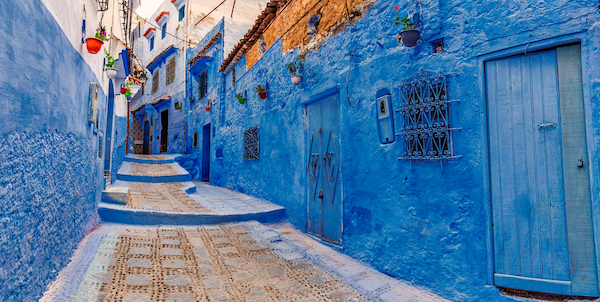
Image via Shutterstock
As Blue as Wine

Image via Shutterstock
As detailed in a 2015 Business Insider report, texts of yore would name all kinds of hues but the color blue. Quite notably, in Homer’s Odyssey, the poet would call the ocean oînops, or “wine-dark,” among other shades—but never blue.
Delving into Homer’s epic poem, scholar William Gladstone, who would later be the Prime Minister of Great Britain in the 19th century, found that Homer would describe black nearly 200 times, make about 100 mentions of white, relate the color red fewer than 15 times, and name the hues yellow and green fewer than 10 times. What was missing was blue, because the term did not exist.
Similarly, philologist Lazarus Geiger discovered no trace of the color being mentioned in ancient Arabic, Chinese, Hebrew, Hindu, and Icelandic literature.
Color Me Intrigued
While one could assume that people would still be able to see blue, even though there was no word for it, there is evidence to prove that language greatly influences how you perceive color.
The color blue still remains undetectable by certain communities today. In an intriguing 2006 study by Goldsmiths University of London psychologist Jules Davidoff and his team, a circle consisting of 11 green squares and a clearly blue square were shown to the Himba tribe from Namibia, who has no word for blue nor a clear distinction between blue and green.
To the researchers’ surprise, the tribe members could not differentiate the colors in the wheel.
On the other end of the spectrum, the Himba people have several names for green, and when those were shown to English speakers, the latter could hardly identify any difference.
To double down the theory that language affects color perception, various shades of blue were shown to native Russian speakers—who have separate terms for light blue (goluboy) and dark blue (siniy)—by a team of MIT researchers in 2007. They were able to point out the lighter and darker shades more easily than English speakers.
[via Science Alert, Grunge, Business Insider, Medium, images via Shutterstock]
Image via Shutterstock
Today, travel guides draw admiration with their poetic descriptions of azure skies and turquoise waters. But these adjectives would have made zero sense to ancestors, no matter how much more pristine the untouched oceans used to be.
That’s because there was very little vocabulary, and by extension, a lack of understanding, of the color.
Image via Shutterstock
As Blue as Wine
Image via Shutterstock
As detailed in a 2015 Business Insider report, texts of yore would name all kinds of hues but the color blue. Quite notably, in Homer’s Odyssey, the poet would call the ocean oînops, or “wine-dark,” among other shades—but never blue.
Delving into Homer’s epic poem, scholar William Gladstone, who would later be the Prime Minister of Great Britain in the 19th century, found that Homer would describe black nearly 200 times, make about 100 mentions of white, relate the color red fewer than 15 times, and name the hues yellow and green fewer than 10 times. What was missing was blue, because the term did not exist.
Similarly, philologist Lazarus Geiger discovered no trace of the color being mentioned in ancient Arabic, Chinese, Hebrew, Hindu, and Icelandic literature.
Color Me Intrigued
While one could assume that people would still be able to see blue, even though there was no word for it, there is evidence to prove that language greatly influences how you perceive color.
The color blue still remains undetectable by certain communities today. In an intriguing 2006 study by Goldsmiths University of London psychologist Jules Davidoff and his team, a circle consisting of 11 green squares and a clearly blue square were shown to the Himba tribe from Namibia, who has no word for blue nor a clear distinction between blue and green.
To the researchers’ surprise, the tribe members could not differentiate the colors in the wheel.
On the other end of the spectrum, the Himba people have several names for green, and when those were shown to English speakers, the latter could hardly identify any difference.
To double down the theory that language affects color perception, various shades of blue were shown to native Russian speakers—who have separate terms for light blue (goluboy) and dark blue (siniy)—by a team of MIT researchers in 2007. They were able to point out the lighter and darker shades more easily than English speakers.
[via Science Alert, Grunge, Business Insider, Medium, images via Shutterstock]
Also check out these recent news


