
17,000-Year-Old Woolly Mammoth’s Tusk Maps Its Entire Travel Route & Life Story

Image via James Havens / University of Alaska Museum of the North
Woolly mammoths were avid travelers, it seems, which isn’t something we might assign to the large, lumbering beasts of the Ice Age.
A study led by Matthew Wooller of the University of Alaska Fairbanks revealed that a woolly mammoth had “covered some serious ground” in its lifetime, with its movements having been tracked using just the remains of its tusk.
The findings showed that it had reached many spots during its tour of Alaska, a feat dubbed “pretty amazing when you think about how big the area is” by Wooller in a statement.
The 17,000-year-old fossil underwent isotope analysis to reach the team’s findings. Its six-foot tusk was split lengthwise, and in total it created about 400,000 microscopic data points.
In particular, the elements strontium and oxygen analyzed in the tusk played a large part in these findings. This data was cross-referenced with maps of isotope variation across Alaska, which was previously created from investigating rodent teeth from around the area. Thus, the mammoth had its own map created, as scientists charted its itinerary by matching the data with the existing maps.
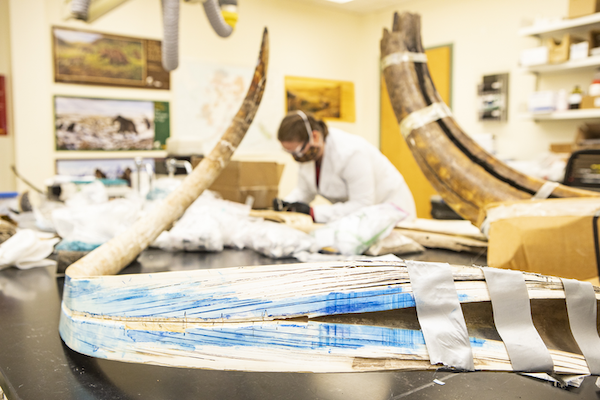
Image via JR Ancheta / University of Alaska Fairbanks
Researchers concluded that this mammoth lived for 28 years. In those years, it managed to cover enough of the Alaskan tundra, taiga, and mountains to be equivalent to circling the world almost twice.
Around age 15, it had been possibly ostracized from its herd, shown in a shift in the data. Later, nitrogen spikes sadly suggested that it met its demise through starvation on Alaska’s North Slope, where the tusk was discovered.
The isotope analyses were made possible due to how mammoth tusks grew. Throughout their lives, new layers of the tusks were added almost daily, somewhat like a diary. When the tusk was split for sampling, the growth bands offered up an almost perfect chronological record of the entire lifetime of that specific mammoth.
“Mother Nature doesn’t usually offer up such convenient and life-long records of an individual’s life,” said Pat Druckenmiller, paleontologist and director of the UA Museum of the North.
This study was newly published in the Science journal just last week.
NSF-supported scientists @uafairbanks tracked the lifetime range of a woolly mammoth that roamed the Arctic 17,100 years ago.
— National Science Foundation (@NSF) August 13, 2021
How did they do it? The tale is in the tusk…https://t.co/IeqfQwaTmj
📷: Univ. of Alaska Fairbanks/JR Ancheta pic.twitter.com/mhTkf3kMvr
[via CNET, images via The University of Alaska Fairbanks]
Also check out these recent news


