
Mars May Be Habitable—Despite Killer Amounts Of Radiation—Thanks To Its Caves
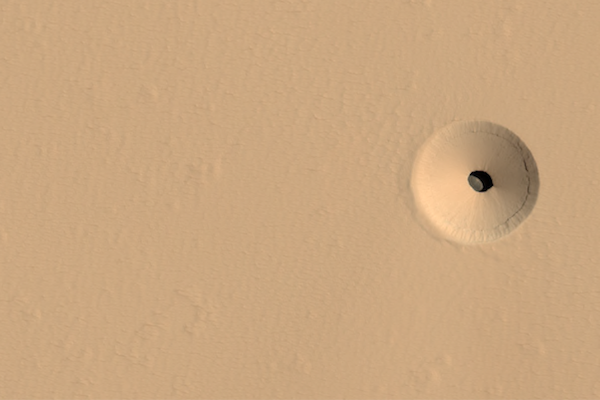
Image via NASA / JPL / University of Arizona
One of the reasons, if not the biggest one, that Mars remains uninhabitable to us humans up to this day is the fact that its desolate reddish surface is host to radiation levels more than 900 times that of the Earth’s.
Situated further from the Sun than us on Earth, Mars receives around 60% of the power per square meter than a similar size on Earth. Theoretically, this should mean that it has less radiation, but the planet lacks a magnetic field like ours to deflect the otherwise harmful particles.
Its atmosphere is also much thinner, notes ZME Science. It doesn’t have protection from the blasts that occur as a result of strong solar flares. In fact, measurements by NASA’s Odyssey probe indicate that radiation levels there are more than 2.5 times what the International Space Station astronauts experience.
People in the US experience around 0.62 rads of radiation exposure per year on average. But someone on Mars would experience eight rads in the same amount of time. That’s besides unforgiving air pressure, among other detrimental conditions.
This all seems pretty bleak, especially considering how this planet has been referred to as a potential alternative habitat for the human population. But there’s hope, and it comes in the form of caves.
“Caves and their entrances have been proposed as habitable environments and regions that could have preserved evidence of life, mostly due to their natural shielding from the damaging ionizing and non-ionizing radiation present on the surface,” a new paper published in the journal Icarus states.
A team of researchers, led by the Spanish National Institute for Aerospace Technology’s Daniel Viúdez-Moreiras, clarify in the paper that “no studies to date have quantitatively determined the shielding offered by these voids on Mars.” But the option is there.
According to their findings, levels of UV radiation inside the “voids” could be as little as 2% of what’s on the surface. This would mean that if humans were to visit—or even populate—the planet for research purposes, they could find refuge in caverns, potentially allowing for longer and safer missions.
The levels of radiation are also potentially conducive to plant life, the researchers state. Humans on the planet could almost be self-sustaining, so long as they find and maintain a plant food source.
And, a report by the Scientific American reveals that there are more than 1,000 suitable caves on Mars thus far. Just like how humans started in caves on Earth, it looks like we’ll be starting in caves on Mars, too. Take your pick.
[via ZME Science, image via NASA / JPL / University of Arizona]
Also check out these recent news


