
Strange Half-Formed Star Named ‘The Accident’ Defies What Astronomers Have Known

Image via NASA/JPL-Caltech/UCLA
A star named ‘The Accident’ was discovered, as you can probably guess, by accident. A citizen astronomer, Dan Caselden, had been looking for brown dwarfs and was studying a totally different group of them when this particular one decided to steal the show.
Following this, scientists have determined that it employs speeds of up to half a million miles per hour, zipping through space faster than any other brown dwarf known to date. The Accident, as NASA details, “slipped past normal searches” as it doesn’t resemble any of the previously found brown dwarfs.
Brown dwarfs, as explained by Live Science, are considered not-quite-stars. Despite their huge bodies, which can reach up to 80 times Jupiter’s size, they don’t have the mass required to ignite nuclear fusion in their cores—the last step to becoming a star.
They’re also hard to detect because they lose heat over time, so are subject to a rather invisible life of whizzing through space.
“It’s not a surprise to find a brown dwarf this old, but it is a surprise to find one in our backyard,” says Federico Marocco, an astrophysicist at Caltech who led the new observations, in a statement.
“We expected that brown dwarfs this old exist, but we also expected them to be incredibly rare. The chance of finding one so close to the solar system could be a lucky coincidence, or it tells us that they’re more common than we thought.”
The Accident is a conundrum in itself as it appears both extremely young and old at the same time. This has baffled the team, with Davy Kirkpatrick, an author of the study published in The Astrophysical Journal Letters, declaring that “this object defied all our expectations.”
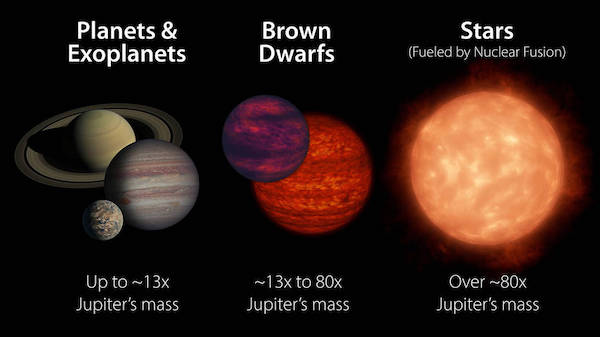
Image via NASA/JPL-Caltech
The infrared light detected by astronomers indicates that it’s cold, a sign of old age. And it usually looks pretty dim. But in other wavelengths, it appears brighter, which suggests that it’s young.
Its speed argues for older age, though, as its 500,000mph travels can be attributed to accumulating “massive objects” from the time spent “careening around the galaxy.”
Another suggestion is the methane in its composition; although a common material found in brown dwarfs, The Accident’s light profile shows that it contains abnormally little. Since methane absorbs specific wavelengths of light, a brown dwarf lacking in it would appear dimmer.
This could’ve been what happened to The Accident. If it was formed all those millions of years ago, when the galaxy was still carbon-poor, it would give it a reason to appear dimmer at times.
It’s been stated in the study that “verification, refutation, or further befuddlement” will be possible using the James Webb Space Telescope, which is ready to launch. Perhaps this isn’t the last we’ll be hearing of The Accident.
[via TechRadar, images via NASA/JPL-Caltech/UCLA]
Also check out these recent news


