
Scientists Unveil World’s Largest Lab-Grown Steak To Sink Your Teeth Into
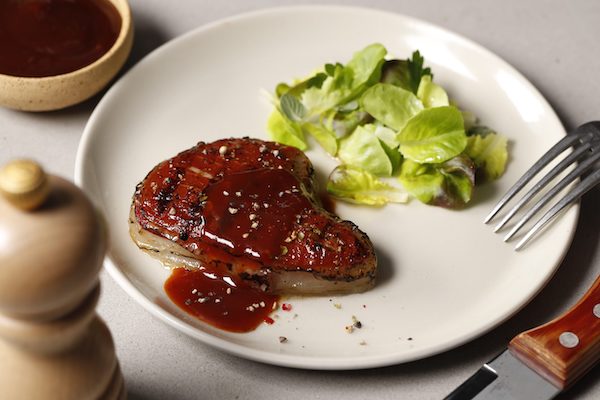
Image via MeaTech
An Israeli firm, MeaTech, has produced the world’s largest lab-grown steak to date—with it weighing in at nearly 4oz (110 grams).
Meat lovers can actually sink their teeth into the hyper-realistic flank, which is composed of real muscle and fat cells taken from tissue samples of a cow.
Living bovine stem cells were added into the “bio-inks” used by the 3D printer to produce the steak. The meat was then matured in an incubator, where the stem cells turned into more fat and muscle cells.
“The breakthrough is the culmination of over one year’s efforts in our cellular biology and high-throughput tissue-engineering processes, as well as our precision bio printing technology,” said Sharon Fima, CEO of MeaTech.
“We believe we have placed ourselves at the forefront of the race to develop high-end, cell-based meat products.”
Fima said the company’s end goal was to produce lab-grown meat at the same cost as conventional slaughterhouses, with the team currently working on cell lines for pork and chicken substitutes.
For now, these 3D-printed meats are unlikely to appear at dinnertime anytime soon. MeaTech first plans to enter the market by selling the cultured fat as an ingredient for other products, instead of whole steaks.
“The MeaTech announcement marks an exciting step forward in terms of the complexity and sheer size of a cultivated steak,” Seren Kell at the Good Food Institute (GFI) Europe told The Guardian.
“3D printing enables companies to create more sophisticated ‘whole cut’ products which can authentically recreate the taste, texture, and mouthfeel of conventional meat,” she said.
However, an industry insider told the site that as 3D printing has become more widespread in recent years, MeaTech may have to further prove its technology can be scaled up to produce these steaks at a lower cost.
“The race is on to produce whole-cut steaks, fish fillets, and other meats using cellular agriculture,” said Kell.
“But to make these innovations accessible and to achieve the huge environmental, public health, and food security benefits of cultivated meat as quickly as possible, we need governments to invest billions in research and commercialization,” she explained.
[via The Guardian, cover image via MeaTech]
Also check out these recent news


