
After Use, Wind Turbine Blades Can Be Recycled Into… Gummy Bears
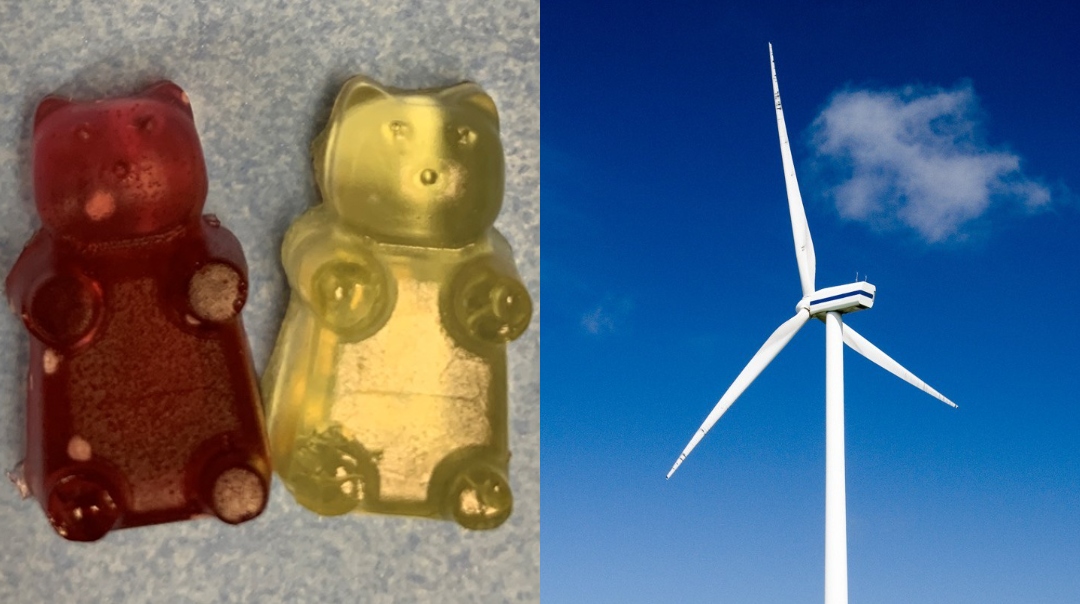
Renewable energy comes at a cost, it would seem, as wind turbine blades will have to be replaced every so often. So what do we do with all this steel and plastic?
Turn it into gummy bears, obviously!
In order to prevent turbines from ending up in landfills and negating their intended use to solve our climate crisis, a team at Michigan State University has found a way to create the blades from a resin that can be reused over and over again.
This new wind turbine material combines glass fibers and synthetic and organic polymers to create a resin. This compound can then be recycled a lot more easily than normal resin can.
According to the research team, it can be recycled infinitely, in fact, achieving a circular economy.
Glass fiber can be filtered out of its residual fiber and what remains can be recast into new wind turbines... or candy.
All of it depends on how scientists manipulate its broken-down structure. By adding an alkaline solution, they ended up with a substance used in making windows and car taillights. Toying with the temperature then led them to a highly absorbent polymer used in diapers.
When mixed with other substances, it could yield different properties to make everything from kitchen countertops to laptop covers.
But in order to make gummy bears, the team recovered food-grade potassium lactate. However, candy isn’t the only food it can be turned into as it can produce sports drinks from the same compound.
If that idea is too far out there for your liking, John Dorgan, who will be leading the presentation at the American Chemical Society (ACS) Fall 2022 meeting, stated that food derived from plants is no different from carbon atoms derived from fossil fuels. The study essentially proves how carbon can go from plastic back to food.
But you probably won’t be seeing wind turbine-turned-gummies in your local supermarket any time soon. According to the study, there isn’t enough bioplastic to actually produce enough to take these unique sweets to market.
As of right now, wind turbines are unfortunately ending up in landfills. However, certain countries like Denmark are turning them into bicycle shelters, while other parts of the world are using them to grow coral reefs.
[via CNET and The Guardian, cover image via John Dorgan/Michigan State University and Photo 2431128 © Sebastian Czapnik | Dreamstime.com]


