
NASA’s Webb Telescope Detects Carbon Dioxide On A Far-Flung Exoplanet

For the first time, researchers at NASA have detected carbon dioxide on an exoplanet located outside of our solar system, capturing the evidence in the atmosphere of gas giant planet 700 light-years away.
The findings, discovered using the space agency’s new James Webb Space Telescope (JWST), suggest that the equipment could be used in the future to measure carbon dioxide in the atmospheres of other orbits.
Scientists found that WASP-39 b, the hot gas giant first identified in 2011, had a mass similar to that of Saturn, and a diameter 1.3 times greater than Jupiter. Unlike the planets in our solar system, this exoplanet revolved very closely around its star, taking only four Earth-days to complete a circuit.
Previous sightings of the planet, including with Hubble and Spitzer, showed that there was water vapor, sodium, and potassium present in its atmosphere, though the JWST is the first to confirm carbon dioxide.
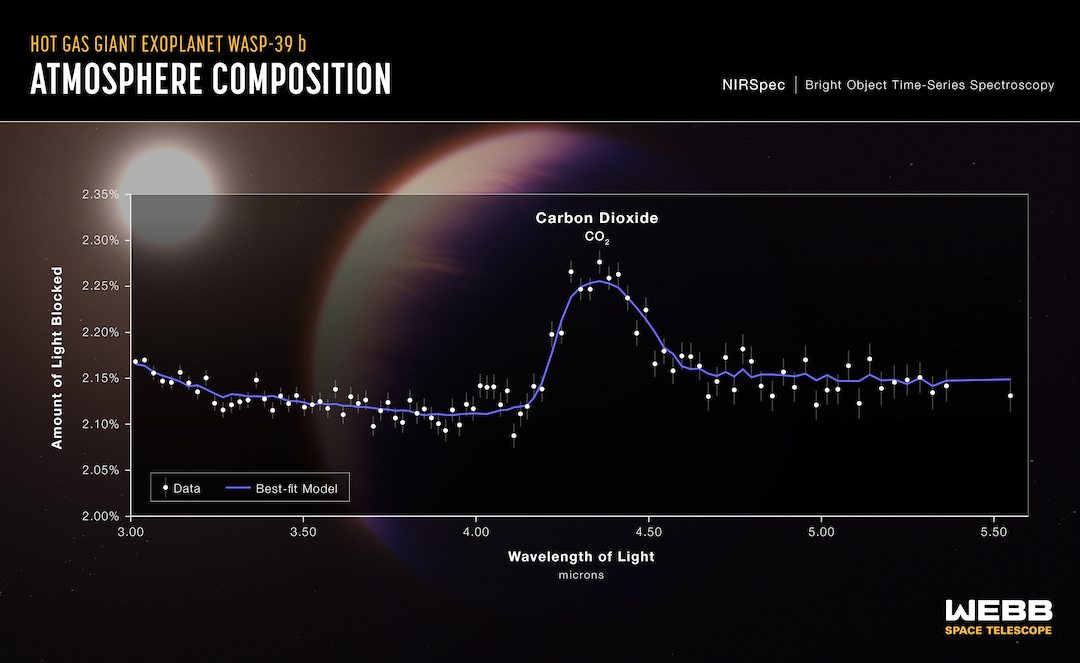
Researchers used the telescope’s Near-Infrared Spectograph NIRSpec) for its observations, spotting a small hill between 4.1 and 4.6 microns—the first time such subtle differences had ever been measured—that provided the evidence for the presence of carbon dioxide.
“As soon as the data appeared on my screen, the whopping carbon dioxide feature grabbed me. It was a special moment, crossing an important threshold in exoplanet sciences,” explained Zafar Rustamkulov, a member of the JWST Transiting Exoplanet Community Early Release Science team.
“Carbon dioxide molecules are sensitive tracers of the story of planet formation,” said Mike Line of Arizona State University.
“By measuring this carbon dioxide feature, we can determine how much solid versus how much gaseous material was used to form this gas giant planet. In the coming decade, JWST will make this measure for a variety of planets, providing insight into the details of how planets form and the uniqueness of our own solar system,” he added.
[via Interesting Engineering and NASA, cover image via Ig0rzh | Dreamstime.com]


